Pak follows India; to ban high denomination banknotes in corruption fight
21 Dec 2016
Weeks after India demonetised its high-value rupee bills, Pakistan's Senate on Monday passed a resolution seeking withdrawal of the high denomination Rs5,000 currency notes ''in a phased manner'' to curb the flow of black money.
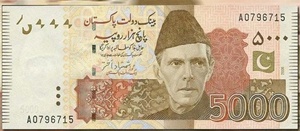
The resolution proposes complete withdrawal of the high-denomination currency notes from the market within the next three to five years.
Senator Usman Saifullah of the opposition Pakistan People's Party (PPP) tabled the resolution to ban the notes, arguing that the Rs5,000 note was being used in illegal transactions and should be withdrawn.
The resolution was endorsed by the majority of lawmakers in the Upper House, although it was strongly opposed by the ruling Pakistan Muslim League-Nawaz (PML-N) government.
Since the PPP has a majority in the upper house of parliament, the resolution was endorsed.
A member of Pakistan People's Party said that the government must withdraw the highest denomination currency note "in order to reduce the illicit money flow, encourage the use of bank accounts and reduce the size of undocumented economy".
The resolution said the withdrawal of Rs5,000 notes will encourage the use of bank accounts and reduce the size of the undocumented economy, Dawn reported.
In Pakistan, which is ranked 117th among 175 in the 2015 Corruption Perceptions Index reported by Transparency International, the Rs5,000 bills are mostly used in illegal transactions.
Pakistan's rank for corruption averaged 107.90 from 1995 until 2015, reaching an all-time high of 144.00 in 2005.
Opposing the resolution, law minister Zahid Hamid said that the move would have repercussions on the economy and the masses in general, as has been happening in neighbouring India. He also said that withdrawal of the notes would create crisis in the market and people would resort to foreign currencies in the absence of the Rs5,000 notes.
Hamid said that around 3.43 trillion Rs5,000 banknotes were in circulation in Pakistan - around 30 per cent of the total currency in flow in Pakistan now.
"Such a huge number of currency notes cannot be pulled from circulation without causing a monetary crises. If such steps are taken, people will lose confidence in the Pakistani rupee and will instead prefer foreign currency due to the steep drop in supply of local currency notes," the minister said.
Senator Saifullah suggested that instead of withdrawing the Rs5,000 currency note, its printing should be halted and the withdrawal should take place in a time span of three to five years.