New terahertz modulator could lead to more advanced medical and security imaging
19 Jul 2014
A University of California, Los Angeles (UCLA) Henry Samueli School of Engineering and Applied Science research team has developed a breakthrough broadband modulator that could eventually lead to more advanced medical and security imaging systems.
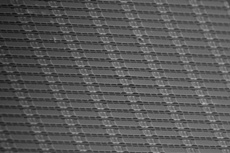 | |
| Electron microscope image showing the metasurface for a terahertz modulator developed by a group led by UCLA professor Mona Jarrahi (UCLA Engineering) |
Modulators manipulate the intensity of electromagnetic waves. For example, modulators in cell phones convert radio waves into digital signals that the devices can use and understand. In terahertz-based communication and imaging systems, they modify the intensity of terahertz waves.
Today's technologies take advantage of many parts of the electromagnetic spectrum - notably light waves and radio waves - but they rarely operate in the terahertz band, which lies between infrared and microwave on the spectrum.
Led by Mona Jarrahi, UCLA associate professor of electrical engineering, the group developed a terahertz modulator that performs across a wide range of the terahertz band with very high efficiency and signal clarity.
Among the device's advantages are that it could easily be incorporated into existing integrated circuit manufacturing processes, can operate at room temperature and does not require an external light source to operate.
The terahertz band has been the subject of extensive research, in large part because of its potential for medical imaging and chemical sensing technologies. For example, terahertz waves could be used to examine human tissue for signs for disease without damaging cells or the other health risks posed by X-rays. They also could be used in security screenings to penetrate fabric or plastics that conceal weapons.
Current optical modulators that use naturally existing materials, such as silicon or liquid crystals, to manipulate the intensity of light waves have proven to be very inefficient in terahertz frequencies.
And modulators based on artificial materials, so-called metamaterials, thus far have a limited use because they only operate in a narrow band of the terahertz range.
The new modulator is based on an innovative artificial metasurface - a type of surface with unique properties that is defined by the geometry of its individual building blocks, and their arrangement. The metasurface developed by Jarrahi's team is composed of an array of micro-electromechanical units that can be opened and closed using electric voltage. Opening or closing the metasurface encodes the incoming terahertz wave into a corresponding series of zeroes or ones, which are then transformed into images.
"Our new metasurface broadens the realm of metamaterials to broadband operation for the first time, and it diminishes many of the fundamental physical constraints in routing and manipulating terahertz waves, especially in terahertz imaging and spectroscopy systems," Jarrahi said. "Our device geometry can switch from an array of microscale metallic islands to an array of interconnected metallic loops, altering its electromagnetic properties from a transparent surface to a reflecting surface, which manipulates the intensity of terahertz waves passing through over a broad range of frequencies."
The research was published 16 July in the journal Nature Scientific Reports.
The study's lead authors are Mehmet Unlu and Mohammed Reza Hashemi, who were postdoctoral scholars in Jarrahi's group when she was a member of the faculty at the University of Michigan. Other authors are Christopher Berry and Shenglin Li, former students in Jarrahi's group, and Shang Hua Yang, a current UCLA graduate student.
The research was funded by the National Science Foundation's Sensor and Sensing Systems Division and an Army Research Office Young Investigator award.