Iceland becomes first nation to legislate equal pay for women
05 Jan 2018
Iceland has set an example in the new year for the world to follow, or so at least women would agree. A law which was passed in June last year and came into effect on 1 January makes it mandatory for companies to demonstrate that they pay their female and male employees equally.
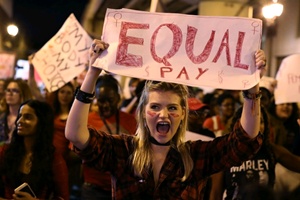
This makes it the first country in the world to legalise equal pay between men and women.
Ranked number one in World Economic Forum's Global Gender Gap Index, Iceland has championed the cause of women rights and had made it illegal to pay women and men differently on the basis of their gender as early as 1963.
Iceland in June 2017 put the onus of mandating the 'Equal Pay Standards' on institutions instead of the employee filing a complaining about gender discrimination.
The system was in works since 2012 and in June last year the 'Act on Equal Status and Equal Rights of Women and Men' was amended making it mandatory for organisation with 25 or more employees to get certified by a certification body confirming that the payroll system and its implementation comply with the requirements of the law.
Under the new rules, companies and government agencies employing at least 25 people will have to obtain government certification of their equal-pay policies. Those that fail to prove pay parity will face fines.
"The legislation is basically a mechanism that companies and organisations ... evaluate every job that's being done, and then they get a certification after they confirm the process if they are paying men and women equally," said Dagny Osk Aradottir Pind, a board member of the Icelandic Women's Rights Association.
"We have had legislation saying that pay should be equal for men and women for decades now but we still have a pay gap."
Iceland, an island country in the North Atlantic Ocean that is home to approximately 323,000 people, has a strong economy, based on tourism and fisheries.
For the past nine years, it has been ranked by the World Economic Forum (WEF) as the world's most gender-equal country.
The Global Gender Gap Report uses markers such as economic opportunity, political empowerment, and health and survival to gauge the state of gender equality in a country.
Since the reports began in 2006, Iceland has closed around 10 percent of its total gender gap, making it one of the fastest-improving countries in the world.
The new legislation was supported by Iceland's centre-right government, as well as the opposition, in a parliament where nearly 50 per cent of all members are women.
The current coalition government in its 'Agreement' for coalition had affirmed its commitment to equal pay certification stating that ''Deliberate steps will be taken to eradicate gender-based wage discrimination. For this purpose, it will be necessary, amongst other things, to publicise the gender pay-gap more prominently, e.g. in companies' annual financial statements. It must be ensured that comparable jobs are evaluated in a comparable manner, in accordance with the demands that are made of enterprises according to law and that are supposed to be reflected in the new Equal Pay Standard.''
The Icelandic government plans to completely eradicate the wage gap by 2020.
Rwanda among top 5
According to the latest WEF report, the top five best performers in the global gender gap are Iceland, Norway, Finland, Rwanda and Sweden.
Yemen, on the other hand, is currently the lowest-ranked of the 144 countries measured in the report. The war-torn country has been low-performing in terms of economic participation and opportunity for several years.
Fifty-two countries fell below the global average in 2017, including China, Liberia and the United Arab Emirates, while 60 saw their overall gender gap decrease.
Hungary was the only European country to be ranked lower than the global average, having scored poorly on political empowerment.