CeNS researchers use organic molecule to tune optical properties of liquid crystals
27 Jan 2024
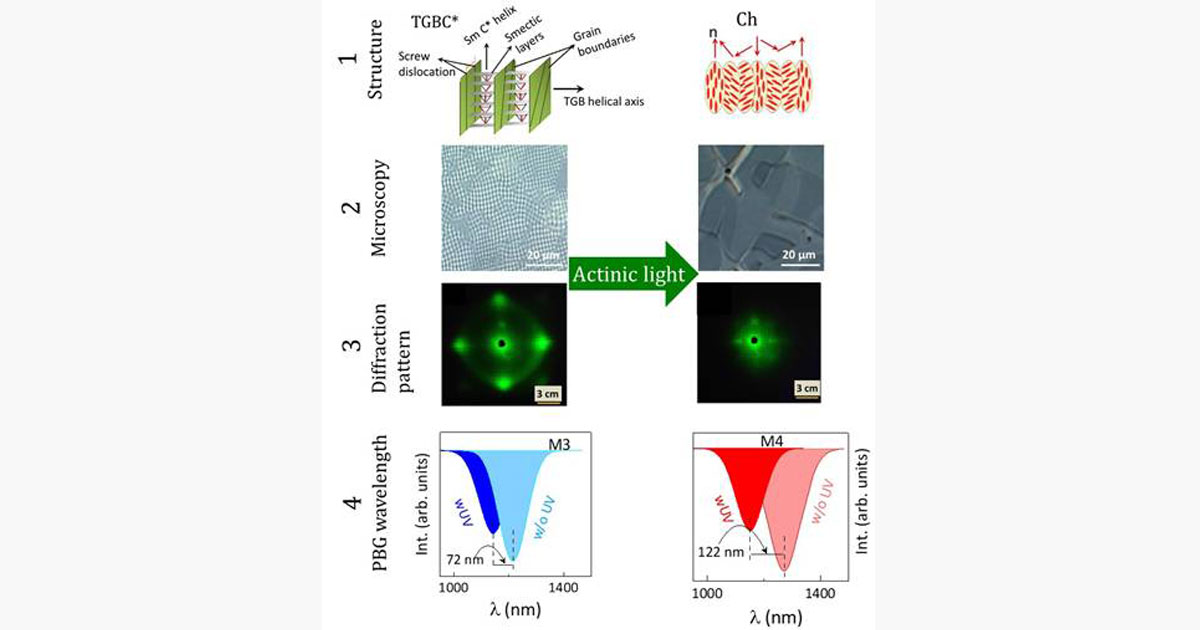
Scientists at the Centre for Nano and Soft Matter Sciences (CeNS) have successfully tuned the unwanted bands of wavelength in liquid crystals by doping it with organic molecules that are photoactive dimers, a development that can be useful in the development of new generational optical devices.
Photonic crystals (PCs), which have the ability to modulate, finds increasing use in developing new-generation optical devices. The periodic dielectric structure of PCs gives rise to unwanted bands of wavelength or photonic band gap (PBG). The band gap corresponds to the frequencies/wavelengths of electromagnetic radiation that are not transmitted through the material.
Among various PBG structures, liquid crystals (LCs), where molecules self-organise into a periodic structure, are gaining attention due to their capability to self-assemble.
Liquid systems exhibit PBG structures in two phases and display periodic structures in one and three dimensions, respectively. Scientists have found that the PBG properties of these systems can be easily altered by external stimuli like temperature, doping with nanoparticles, etc.
The CeNS scientists have demonstrated the impact of ultraviolet light on the one-dimensional and three-dimensional PBG features of the LC systems.
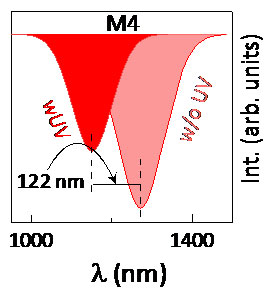
By incorporating small amounts of guest photoactive organic compounds with a structure containing two identical or similar units (dimers), the wavelength and the width of the PBG in 1-or 3-dimensions could be tuned in the presence of UV light.
This feature, according to the scientists, may find application as a selective wavelength mirror whose wavelength can be optically tuned. Another interesting fact is the memory effect observed in two-dimensional PBG dictated by UV or actinic light, a feature holding promise for memory devices.
This research work, published in ‘Journal of Molecular Liquids, was carried out by Rajalaxmi Sahoo, Reshma C, DS Shankar Rao, CV Yelamaggad, and S Krishna Prasad.