Nanomagnets offer food for thought about computer memories
29 Jun 2011
Magnetics researchers at the National Institute of Standards and Technology (NIST) colored lots of eggs recently. Bunnies and children might find the eggs a bit small-in fact, too small to see without a microscope. But these "eggcentric" nanomagnets have another practical use, suggesting strategies for making future low-power computer memories.
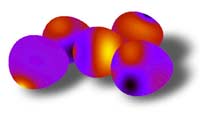 |
| Collage of NIST "nano-eggs" - simulated magnetic patterns in NIST's egg-shaped nanoscale magnets.Credit: Talbott/NIST |
For a study described in a new paper,* NIST researchers used electron-beam lithography to make thousands of nickel-iron magnets, each about 200 nanometers (billionths of a meter) in diameter. Each magnet is ordinarily shaped like an ellipse, a slightly flattened circle. Researchers also made some magnets in three different egglike shapes with an increasingly pointy end. It's all part of NIST research on nanoscale magnetic materials, devices and measurement methods to support development of future magnetic data storage systems.
It turns out that even small distortions in magnet shape can lead to significant changes in magnetic properties. Researchers discovered this by probing the magnets with a laser and analyzing what happens to the "spins" of the electrons, a quantum property that's responsible for magnetic orientation. Changes in the spin orientation can propagate through the magnet like waves at different frequencies. The more egg-like the magnet, the more complex the wave patterns and their related frequencies. (Something similar happens when you toss a pebble in an asymmetrically shaped pond.) The shifts are most pronounced at the ends of the magnets.
To confirm localized magnetic effects and "color" the eggs, scientists made simulations of various magnets using NIST's object-oriented micromagnetic framework (OOMMF).** (See graphic.) Lighter colors indicate stronger frequency signals.
The egg effects explain erratic behavior observed in large arrays of nanomagnets, which may be imperfectly shaped by the lithography process. Such distortions can affect switching in magnetic devices. The egg study results may be useful in developing random-access memories (RAM) based on interactions between electron spins and magnetized surfaces. Spin-RAM is one approach to making future memories that could provide high-speed access to data while reducing processor power needs by storing data permanently in ever-smaller devices. Shaping magnets like eggs breaks up a symmetric frequency pattern found in ellipse structures and thus offers an opportunity to customize and control the switching process.
"For example, intentional patterning of egg-like distortions into spinRAM memory elements may facilitate more reliable switching," says NIST physicist Tom Silva, an author of the new paper.
"Also, this study has provided the Easter Bunny with an entirely new market for product development."