New malleable 'electronic skin' self-healable, recyclable
10 Feb 2018
University of Colorado Boulder (CU Boulder) researchers have developed a new type of malleable, self-healing and fully recyclable "electronic skin" that has applications ranging from robotics and prosthetic development to better biomedical devices.
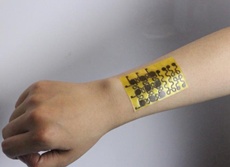 | |
| A section of E-Skin / Jianliang Xiao / University of Colorado Boulder |
Electronic skin, known as e-skin, is a thin, translucent material that can mimic the function and mechanical properties of human skin. A number of different types and sizes of wearable e-skins are now being developed in labs around the world as researchers recognize their value in diverse medical, scientific and engineering fields.
The new CU Boulder e-skin has sensors embedded to measure pressure, temperature, humidity and air flow, said Assistant Professor Jianliang Xiao, who is leading the research effort with CU Boulder chemistry and biochemistry Associate Professor Wei Zhang.
It has several distinctive properties, including a novel type of covalently bonded dynamic network polymer, known as polyimine that has been laced with silver nanoparticles to provide better mechanical strength, chemical stability and electrical conductivity.
"What is unique here is that the chemical bonding of polyimine we use allows the e-skin to be both self-healing and fully recyclable at room temperature," says Xiao. "Given the millions of tons of electronic waste generated worldwide every year, the recyclability of our e-skin makes good economic and environmental sense."
A paper on the subject was published today in the journal Science Advances. Co-authors on the study include Zhanan Zou and Yan Li of mechanical engineering and Chengpu Zhu and Xingfeng Lei of chemistry and biochemistry. The study was funded in part by the National Science Foundation.
Many people are familiar with the movie The Terminator, in which the skin of film's main villain is "re-healed" just seconds after being shot, beaten or run over, said Zhang.
While the new process is not nearly as dramatic, the healing of cut or broken e-skin, including the sensors, is done by using a mix of three commercially available compounds in ethanol, he said.
Another benefit of the new CU Boulder e-skin is that it can be easily conformed to curved surfaces like human arms and robotic hands by applying moderate heat and pressure to it without introducing excessive stresses.
"Let's say you wanted a robot to take care of a baby," says Zhang. "In that case you would integrate e-skin on the robot fingers that can feel the pressure of the baby. The idea is to try and mimic biological skin with e-skin that has desired functions."
To recycle the skin, the device is soaked into recycling solution, making the polymers degrade into oligomers (polymers with polymerization degree usually below 10) and monomers (small molecules that can be joined together into polymers) that are soluble in ethanol. The silver nanoparticles sink to the bottom of the solution.
"The recycled solution and nanoparticles can then be used to make new, functional e-skin," said Xiao.