Laser scan at full speed
08 May 2012
Is a contact wire missing or is it faulty? What's the situation in front of the entrance to a railway station or a tunnel? A 3D laser scanner can increase the train's safety and reliability.
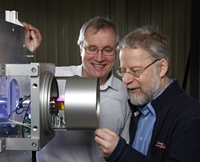 Laser systems can be used to implement highly precise and ultra-fast measuring processes. Railway measuring technology has a huge worldwide need here. One prerequisite for its use is that nobody is damaged or suffers irritations by the laser. Dr. Heinrich Höfler and Dipl.-Ing. Harald Wölfelschneider from the Fraunhofer Institute for Physical Measurement Techniques IPM in Freiburg have worked with their team to develop a 3D laser scanner.
It can be used outdoors without hesitation. Extremely fast and precise, it is able to spatially measure and monitor the position of the contact wire or the track from a train travelling at up to 100 kilometers (62 mph) per hour. If the scanner is stationary, it can capture passing trains and check for loads that might have slipped.
Heinrich Höfler explains how that works, ''We send off a laser beam and wait until it returns. We measure the time in between and that tells us how far away an object is.'' The difficult part is capturing the returning beam. Often, only very little light comes back and what's more, the transmitted light beam is back in an extremely short space of time. The solution, was a kind of slow motion. The laser beam is very rapidly switched on and off – modulated, as scientists would put it. The time shift of this modulation wave can be determined more quickly and precisely than is possible with a single laser pulse.
The system measures, by default, one million times per second.
''For Deutsche Bundesbahn (German Railway), we equipped a measurement train that scans the surroundings of the test track, using several laser beams and which delivers, taking four million measurements per second, a 3D image of what it scans'', explains Harald Wölfelschneider. That allows even small obstacles and constrictions to be detected, or we can plan the route via which a heavy load can best be transported to its destination.
Another field of application is the measuring of passing trains. This requires the scanner to be permanently mounted, which, however, does increase the chance of someone looking into the laser beam for a longer period. To make the scanner safe for the human eye, the researchers had to develop a new wavelength range: infrared, which is harmless for our eyes. The consequence being that the entire system had to be fully reconfigured.
If we examine railways carefully, it makes sense that we then also examine other traffic routes, such as roads. The team at IPM has developed a 3D scanner, safe for the human eye, which is mounted onto a moving car and which scans the road from a height of about three meters.
''We can now detect height differences of even 0.2 millimeters on the road, even at speeds of 80 kilometers per hour (approx. 50 mph)'', says Höfler. This is the first scanner approved for this purpose by the Federal Highway Research Institute. It is to detect lane grooves, potholes and water drainage potentials.
The laser system has already been marketed and used successfully all over the world for rail traffic safety. Not only fast and precise, this system is also highly robust. Dr. Heinrich Höfler and Dipl.-Ing. Harald Wölfelschneider will receive one of the 2012 Joseph-von-Fraunhofer awards for this eye-safe 3D laser scanner.

























