Unlocking the secrets of DNA repair
06 Nov 2012
Scientists from the University of Sheffield have unlocked one of the secrets to DNA repair – helping doctors identify DNA base damage and a patient's susceptibility to certain types of cancer.
Groundbreaking research led by Dr David Williams from the University of Sheffield's department of chemistry and an international collaboration of expert researchers has discovered how some proteins recognise damaged bases within DNA which, if untreated, could lead to cancer.
Dr Williams says, "Proteins carry out all the day-to-day processes needed for survival. If the DNA bases become damaged the associated protein may not function or in some cases, too much of a certain protein can be produced – which might lead to cancer.
"Everyday humans are exposed to chemicals known as alkylating agents, which may be derived from environmental sources or from dietary sources such as a high intake of red or processed meat or exposure to tobacco smoke. Alkylating agents can chemically modify the bases in DNA which can, in turn, lead to non-functional proteins being produced or indeed cancer.
"Fortunately humans have a large number of different DNA repair proteins whose task it is to find and repair damaged bases in DNA. However DNA base damage, although highly problematic, is rare and often only one or two bases per million or even fewer. The task of locating a damaged base is similar to finding a needle in a haystack."
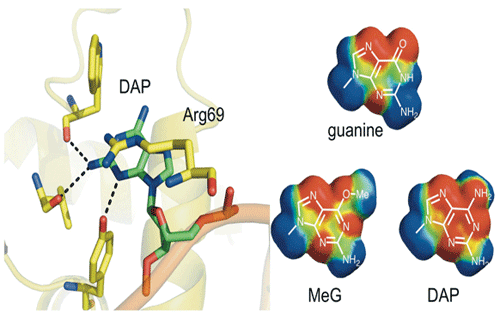
CAPTION: The figure shows a zoomed in structure (derived by X-ray crystallography) of a complex between Atl1 and DNA containing 2,6-diaminopurine, an analogue that has the same electrostatic charge characteristics as O6-alkylguanine
DNA contains all the information needed for life within the sequence of its four bases; adenine, cytosine, guanine and thymine. Specific sequences of bases in DNA known as genes instruct what proteins are made and furthermore genes may be switched on or off to control how much of each protein is made.
The pioneering research, published in the journal, Proceeding of the National Academy of Sciences of the United States of America (PNAS), was conducted by scientists from the University of Sheffield, University of Manchester and the Scripps Research Institute in California and focuses on damage to the guanine base to form O6-alkylguanine, a type of damage that is particularly prevalent in colon or bowel cancer.
"In humans this is repaired by alkyltransferase proteins that simply reverse the damage of these modified bases, converting them back to guanine," said Dr Williams.
"We have uncovered an exquisite mechanism whereby a positively charged side chain of the amino acid arginine found in the Alt1 protein is used to check the electronic charge distribution across the DNA base, which is altered by alkylation damage.
"This method of recognition, we believe, may also be used by many other DNA repair proteins to recognise damaged bases within DNA. A further exciting discovery we have made is to show that the alkyltransferase-like protein Alt1 can detect all known types of O -alkylguanine modification.
"Consequently, Alt1 has potential for use in identifying and quantifying levels of certain O6- alkylguanines in human tissue biopsies. This would be informative to clinicians about individual susceptibility to certain cancers, particularly colorectal."