Antarctica bacteria thriving without oxygen, sunlight
18 Apr 2009
Sunlight and oxygen have been considered necessary for the development of life. But the latest discovery by scientists investigating in the frigid snows of Antarctica may completely nullify this hypothesis.
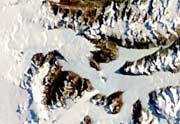 The McMurdo Dry Valleys of Antarctica are one of the last places on Earth one would expect to find a new living organism. With bitter cold temperatures and only about four inches of annual snowfall, scientists consider these valleys to be one of Earth's most extreme and harsh environments.
The region was believed to be devoid of complex animal and plant life, but a new study has revealed that an unusual microbial life form lives under the Taylor Glacier - an outlet glacier that drains part of the East Antarctic Ice Sheet and terminates in the Dry Valleys. An intriguing trademark of Taylor Glacier is the appropriately named Blood Falls - a waterfall-like feature at the glacier's terminus that is stained a blood-red colour due to the presence of iron compounds.
A team of researchers led by Jill Mikucki, a geobiologist at Dartmouth College, took samples from a pond of briny liquid, similar to seawater but buried under the glacier. Analysis revealed that the liquid supported a community of microbes living in a place where lack of sunlight and oxygen would have led scientists to believe that nothing could live there.
"Among the big questions here are: 'How does an ecosystem function below glaciers?', 'How are they able to persist below hundreds of meters of ice and live in permanently cold and dark conditions for extended periods of time, in the case of Blood Falls, over millions of years?" said Mikucki.
John Priscu, of Montana State University, said that because the ecosystem has been isolated for so long in extreme conditions, it could help explain how life might exist on other planets, and serve as a model for how life can exist under ice.
Until fairly recently, researchers believed that living organisms couldn't survive in such extreme environments, such as under glaciers or ice sheets. But we now know that some organisms -- called extremophiles - not only survive, but thrive in these intense environments, such as in Yellowstone National Park's hot springs and in volcanic vents on the ocean floor called black smokers, which release hot water and molten rock.
If life exists on Mars, scientists believe it is most likely to be in pockets of liquid water beneath the Martian surface. These underground water chambers could harbor microscopic organisms that have evolved unique strategies for survival - much like the ones under Taylor Glacier.
The researchers believe the pool of water was trapped about 1.5 million years ago when the glacier moved over a lake. It doesn't freeze because it is four times saltier than the ocean. The pools is so deep under the ice and so far back from the edge that the researchers couldn't drill down to it, but they were able to collect some of the outflow for testing.
The researchers concluded that the ancestors of the bacteria probably lived in the ocean millions of years ago and when the Antarctic valleys rose a pool of seawater was trapped and was eventually capped by the flow of the glacier. The research was funded by the National Science Foundation, Canadian Institute for Advanced Research, Harvard Microbial Sciences Initiative and the National Aeronautics and Space Administration.