Poor monsoon puts Kerala in power crisis
29 Jul 2002
Kochi: Experts predict that Kerala is heading for a power crisis in view of the poor monsoon, which has turned the storage of water in the hydel reservoirs of the state rather precarious.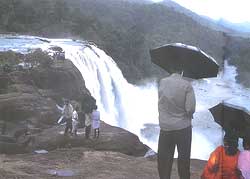 The Kerala State Electricity Board (KSEB) has the option of cutting down on hydel power and going in for more thermal power to tide over the situation. But this would entail heavy financial commitment.
The storage level in the reservoirs is the lowest recorded for the same period in the last five years. The rainfall so far this monsoon has been between 60 and 40 per cent less than the normal level. As of today, the reservoirs have water only for the generation of 470-million units (MU) of power.
A comparison of the situation during the last five years will bring out how serious the position is. On 30 June 2002, the reservoirs had a water equivalent to only 360 MU of electricity. This is against 1,140 MU the same time in 2001, 940 MU in 2000, 1,660 MU in 1999, and 830 MU in 1998.
The average requirement of power in the state comes to 34 MU per day. Currently, 50 per cent of this comes from the hydel stations and 50 per cent from the thermal stations. This means that to retain the existing hydro:thermal mix, the KSEB will have to generate 17 MU of power every day. According to an assessment made by the KSEB last week, after taking into consideration the inflow of water into the reservoirs at the current rate, the existing storage will be hardly adequate to meet the requirement for the next two months. Conserving as much of the water in the reservoirs as possible is the need of the hour.
With this in view, the KSEB is contemplating cutting down on hydel energy, the generation cost of which is just 23 paise per unit. If power-cut is to be avoided, each unit of power generated less at the hydel stations will have to be replaced by a unit of thermal energy, the average cost of generation of which is in the range of Rs 3.70.
According to statistics worked out by the KSEB, if the hydro:thermal mix is brought down from the current level of 50:50 to 40:60, the board will have to spend an additional Rs 30 crore a month on power purchase. The additional cost will be Rs 60 crore a month if the mix is brought down to 30:70. And, if the mix is 20:80, the additional cost will go up to Rs 90 crore a month.
Already, there is a big gap between the income and expenditure of the KSEB. As per the latest data, the monthly income is in the range of Rs 220 crore, whereas the monthly expenditure is nearly Rs 310 crore. The prevailing difference is thus Rs 90 crore on the negative side.
Under these circumstances, the KSEB could in no way afford to take on its shoulders the additional burden of increasing the thermal content in the power supplied, and the only option left is to resort to a power cut.
The state, in fact, has enough source of thermal energy to avoid a power cut. The KSEB is not taking full advantage of the generation capacity at the Kayamkulam station of the National Thermal Power Corporation. Also the Bombay Suburban Electricity Supply power station has stopped the supply of power to the KSEB.
This issue can be sorted out if there is no financial crunch for the KSEB. It is indeed possible to supply uninterrupted power in the state. The only problem is the tariff. If the consumers are ready to pay more, there will be no power crisis here, says a senior KSEB official.
Latest articles








Featured articles

The decoupling paradox: Why Wall Street keeps funding AI despite $100 oil
By Axel Miller | 11 May 2026
AI infrastructure stocks continue rallying despite $100 oil as investors bet on productivity gains and semiconductor demand in 2026.

Hybrid bonding gains attention as AI chip packaging demand grows
By Cygnus | 23 Apr 2026
Hybrid bonding is driving AI chip packaging demand as backend technologies gain importance in the semiconductor supply chain.

The agentic transition: how enterprises are scaling AI from pilot to profit
By Cygnus | 22 Apr 2026
AI has entered its execution era. Discover how companies like Valeo and Microsoft are scaling agentic AI systems—from copilots to autonomous workflows driving real business impact.

Post-splashdown: What Artemis II taught us about the ‘deep space wall’
By Axel Miller | 15 Apr 2026
Artemis II splashdown marks a breakthrough in deep space exploration. Discover AVATAR radiation data, Orion’s distance record, and insights shaping NASA’s 2028 Moon mission.

Can aviation go green? The multi-billion dollar race for sustainable fuel
By Cygnus | 10 Apr 2026
Airlines are racing to adopt sustainable aviation fuel, but limited supply and high costs challenge the future of green aviation.

The battery race: who will control the future of electric vehicles?
By Axel Miller | 08 Apr 2026
The global battery race is reshaping the electric vehicle industry, with China, the US, and Europe competing for control over supply chains and technology.

AI vs governments: Who controls the future of intelligence?
By Cygnus | 07 Apr 2026
Governments and AI companies like OpenAI and Anthropic are shaping the future of intelligence amid rising policy conflicts and global competition.

Strait of Hormuz: how one chokepoint controls the global economy
By Axel Miller | 06 Apr 2026
The Strait of Hormuz is a critical global chokepoint. Learn how disruptions impact oil prices, shipping, and the global economy.

The $2 trillion AI infrastructure race: Who will control global compute?
By Cygnus | 06 Apr 2026
AI spending is set to exceed $2 trillion in 2026, driving a global race in data centers, chips, and energy infrastructure.


Latest articles





