Blair calls for global interdependence
By Our Corporate Bureau | 07 Jan 2002
1
Bangalore:
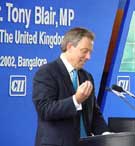
Inaugurating the eighth Partnership Summit, organised by
the Confederation of Indian Industry (CII) at Bangalore,
British Prime Minister Tony Blair said in todays globally-interdependent
world, foreign policy and domestic policy are part of the
same thing. "Fighting international terrorism abroad
is not just right in itself it is vital to our economy,
our jobs, our stability, our security."
 Referring to the terrorist attack on Indian Parliament on
13 December 2001, Blair said: "I view an
attack on your Parliament with every bit as much outrage
as I would an attack on the Parliament in which I sit. The
appalling attacks demonstrate more clearly than ever the
threat such fanatics pose not just to your democracy, but
to all democracies and civilised values in the whole world.
Only politics, not terror, can solve issues like this. The
UK will support Indias nomination as a permanent member
on the UN Security Council."
Referring to the terrorist attack on Indian Parliament on
13 December 2001, Blair said: "I view an
attack on your Parliament with every bit as much outrage
as I would an attack on the Parliament in which I sit. The
appalling attacks demonstrate more clearly than ever the
threat such fanatics pose not just to your democracy, but
to all democracies and civilised values in the whole world.
Only politics, not terror, can solve issues like this. The
UK will support Indias nomination as a permanent member
on the UN Security Council."
 Blair
said: "Any successful economy needs to conform to five
basic principles. Firstly, It should be an open economy,
willing to let capital and goods move freely. It needs financial
and monetary discipline the markets and investors swiftly
punish the profligate. It needs to encourage business and
enterprise to create an enabling climate for entrepreneurs."
Blair
said: "Any successful economy needs to conform to five
basic principles. Firstly, It should be an open economy,
willing to let capital and goods move freely. It needs financial
and monetary discipline the markets and investors swiftly
punish the profligate. It needs to encourage business and
enterprise to create an enabling climate for entrepreneurs."
"Secondly, it should have good governance and democracy, the absence of corruption, respect for human rights. Also needed are well-functioning commercial, fiscal and legal systems.
"Thirdly, the welfare state of the future is based on a social contract between citizens. The relationship cannot simply be one of give by the state and take by the recipient. It must encompass rights and duties.
"Fourthly, global interdependence. Global trade has grown 20-fold since 1947, the year in which India became independent and the GATT was formed. Global finance has grown six-fold in the last 10 years. Todays economies and markets are heavily swayed by that intangible essential confidence. Just a few years ago, the East Asian financial crisis nearly provoked a global slowdown. Tensions in the Middle East can impact on the price of oil. Post-11 September, there has been an immediate effect on the world economy.
"Add to that the information revolution. Its consequences are not only economic. It provides, immediately and across the globe, news, views, information that can excite and influence opinions. Again, after 11 September, the battle was not just military there was a battle for hearts and minds. Would action in Afghanistan be seen as anti-terrorism or anti-Muslim? Had the international coalition been weaker, had the false propaganda that it was anti-Muslim been widely accepted the whole train of events could have been quite different and adversely so."
Blair said if the WTO succeeds, nations prosper. "If the problems of global warming are tackled, every nations environment is helped. If the global financial system is properly ordered, the economies prosper. If international terrorism is defeated, we are all safer. Very few of these problems can be addressed effectively other than by common action. Hence the need to make alliances to secure it. Alliances between nations become a vital part of a nations self-interest and standing, its ability to secure the advances it needs.
"Fifthly, rule of politics. In this interdependent world, nations need to define their place in it. Other nations need to know what any particular nation stands for, where it is located in the multiplicity of alliances and interests around it."
He said both India and the UK are in a process of change. "Indias success today is rooted in its long history of civilisation and strong tradition of democracy, grown out of a rich patchwork of ethnicity, religion and language. It is this combination of stability and diversity that gives India such powerful potential.
"Over the last decade, more than ever before, India has been realising its potential. The Green Revolution set the stage, giving India self-sufficiency in food. By opening up its economy in the early 1990s, India released its creative potential, making it one of the fastest-growing economies in the world soon set to join the top 10 much of it based in cutting-edge technologies like IT and biotechnology. And Indias culture too has impacted worldwide."
Blair said India is strong internally, vibrant culturally and economically, and influential internationally. "Its traditions of freedom and democracy make India an obvious partner for us. Its diversity and energy put it in a prime position to benefit from todays globalising world."
Blair said that for Britain, there is both challenge and opportunity. "The days of Empire are long gone. Europe has been at peace for half a century. Britain has the fourth largest economy in the world but our land mass and population inevitably constrain us. We are not a superpower, but we can act as a pivotal partner, acting with others to make sense of this global interdependence and make it a force for good, for our own nation and the wider world. In so doing, I believe we have found a modern foreign policy role for Britain."
 Blair
said the UK is the second-largest trading partner for India.
"Indo-British partnership has been instrumental in
increasing the trade between India and the UK to 5 billion
sterling pounds, more than 1,500 joint ventures and a presence
of 250 Indian companies in the UK."
Blair
said the UK is the second-largest trading partner for India.
"Indo-British partnership has been instrumental in
increasing the trade between India and the UK to 5 billion
sterling pounds, more than 1,500 joint ventures and a presence
of 250 Indian companies in the UK."
Minister for Information Technology Pramod Mahajan complemented CII for organising the Summit in Bangalore, the IT capital of India. Mahajan said India is still one of the fastest-growing economies of the world. "The economies today are no longer isolated and the 11 September events in the US were an attack on World Trade Confidence. India is ready to cooperate with the global community in its war against terrorism. India does not want war against any other country but we would need to exit from the war in our own country were more than 61,000 people have been killed."
Karnataka Chief Minister S M Krishna said the theme of the summit, Local Boundaries Global Frontiers, is apt for the world in which we live today. "Stressing on the universality of the theme, he said the theme is applicable from a farmer in rural India to a teenager that would support him for a lifetime. In harnessing the opportunities and responding to challenges, our responsibilities should be to sustain and catalyse change. A SWOT analysis of the state indicates that Karnataka is blessed with many ingredients of success and strong infrastructure spread throughout the state. The state boasts of more than 40,000 engineering graduates and over 100 R&D institutions."
He said Karnataka also has the leadership position in industrial growth and development. "There are, however, a large number of challenges that need to be met. The setting up of the Apparel Park will further supplement these efforts. An international airport at an investment of $220 million is also on the anvil. Karnataka is the first state in the country to make government functioning more transparent." Referring to the recent World Bank Report, he said Karnataka is the fastest-growing state in the country with an SDP growth of 8.5 per cent.
CII president Sanjiv Goenka said Blairs visit to India has signaled a new agenda for Indo-British trade cooperation. "The bilateral trade between India and the UK is $4 billion and we must double this trade and investments. India and the UK look forward to better partnerships and the prime ministers of both India and the UK will lead both the countries on the same. CII is optimistic about Indias destiny to be the fastest-growing economy in the world. The summit is a symbol of CIIs determination to play its part in the same."
Summit chairman N R Narayanamurthy said 11 September was a turning point in the world history. "The Indo-British Partnership and CII are indeed touched by the presence of Blair, a truly global leader and a leader that reaches out to global frontiers."
Referring to the terrorist attack on Indian Parliament on
13 December 2001, Blair said: "I view an
attack on your Parliament with every bit as much outrage
as I would an attack on the Parliament in which I sit. The
appalling attacks demonstrate more clearly than ever the
threat such fanatics pose not just to your democracy, but
to all democracies and civilised values in the whole world.
Only politics, not terror, can solve issues like this. The
UK will support Indias nomination as a permanent member
on the UN Security Council."Blair
said: "Any successful economy needs to conform to five
basic principles. Firstly, It should be an open economy,
willing to let capital and goods move freely. It needs financial
and monetary discipline the markets and investors swiftly
punish the profligate. It needs to encourage business and
enterprise to create an enabling climate for entrepreneurs.""Secondly, it should have good governance and democracy, the absence of corruption, respect for human rights. Also needed are well-functioning commercial, fiscal and legal systems.
"Thirdly, the welfare state of the future is based on a social contract between citizens. The relationship cannot simply be one of give by the state and take by the recipient. It must encompass rights and duties.
"Fourthly, global interdependence. Global trade has grown 20-fold since 1947, the year in which India became independent and the GATT was formed. Global finance has grown six-fold in the last 10 years. Todays economies and markets are heavily swayed by that intangible essential confidence. Just a few years ago, the East Asian financial crisis nearly provoked a global slowdown. Tensions in the Middle East can impact on the price of oil. Post-11 September, there has been an immediate effect on the world economy.
"Add to that the information revolution. Its consequences are not only economic. It provides, immediately and across the globe, news, views, information that can excite and influence opinions. Again, after 11 September, the battle was not just military there was a battle for hearts and minds. Would action in Afghanistan be seen as anti-terrorism or anti-Muslim? Had the international coalition been weaker, had the false propaganda that it was anti-Muslim been widely accepted the whole train of events could have been quite different and adversely so."
Blair said if the WTO succeeds, nations prosper. "If the problems of global warming are tackled, every nations environment is helped. If the global financial system is properly ordered, the economies prosper. If international terrorism is defeated, we are all safer. Very few of these problems can be addressed effectively other than by common action. Hence the need to make alliances to secure it. Alliances between nations become a vital part of a nations self-interest and standing, its ability to secure the advances it needs.
"Fifthly, rule of politics. In this interdependent world, nations need to define their place in it. Other nations need to know what any particular nation stands for, where it is located in the multiplicity of alliances and interests around it."
He said both India and the UK are in a process of change. "Indias success today is rooted in its long history of civilisation and strong tradition of democracy, grown out of a rich patchwork of ethnicity, religion and language. It is this combination of stability and diversity that gives India such powerful potential.
"Over the last decade, more than ever before, India has been realising its potential. The Green Revolution set the stage, giving India self-sufficiency in food. By opening up its economy in the early 1990s, India released its creative potential, making it one of the fastest-growing economies in the world soon set to join the top 10 much of it based in cutting-edge technologies like IT and biotechnology. And Indias culture too has impacted worldwide."
Blair said India is strong internally, vibrant culturally and economically, and influential internationally. "Its traditions of freedom and democracy make India an obvious partner for us. Its diversity and energy put it in a prime position to benefit from todays globalising world."
Blair said that for Britain, there is both challenge and opportunity. "The days of Empire are long gone. Europe has been at peace for half a century. Britain has the fourth largest economy in the world but our land mass and population inevitably constrain us. We are not a superpower, but we can act as a pivotal partner, acting with others to make sense of this global interdependence and make it a force for good, for our own nation and the wider world. In so doing, I believe we have found a modern foreign policy role for Britain."
Blair
said the UK is the second-largest trading partner for India.
"Indo-British partnership has been instrumental in
increasing the trade between India and the UK to 5 billion
sterling pounds, more than 1,500 joint ventures and a presence
of 250 Indian companies in the UK."Minister for Information Technology Pramod Mahajan complemented CII for organising the Summit in Bangalore, the IT capital of India. Mahajan said India is still one of the fastest-growing economies of the world. "The economies today are no longer isolated and the 11 September events in the US were an attack on World Trade Confidence. India is ready to cooperate with the global community in its war against terrorism. India does not want war against any other country but we would need to exit from the war in our own country were more than 61,000 people have been killed."
Karnataka Chief Minister S M Krishna said the theme of the summit, Local Boundaries Global Frontiers, is apt for the world in which we live today. "Stressing on the universality of the theme, he said the theme is applicable from a farmer in rural India to a teenager that would support him for a lifetime. In harnessing the opportunities and responding to challenges, our responsibilities should be to sustain and catalyse change. A SWOT analysis of the state indicates that Karnataka is blessed with many ingredients of success and strong infrastructure spread throughout the state. The state boasts of more than 40,000 engineering graduates and over 100 R&D institutions."
He said Karnataka also has the leadership position in industrial growth and development. "There are, however, a large number of challenges that need to be met. The setting up of the Apparel Park will further supplement these efforts. An international airport at an investment of $220 million is also on the anvil. Karnataka is the first state in the country to make government functioning more transparent." Referring to the recent World Bank Report, he said Karnataka is the fastest-growing state in the country with an SDP growth of 8.5 per cent.
CII president Sanjiv Goenka said Blairs visit to India has signaled a new agenda for Indo-British trade cooperation. "The bilateral trade between India and the UK is $4 billion and we must double this trade and investments. India and the UK look forward to better partnerships and the prime ministers of both India and the UK will lead both the countries on the same. CII is optimistic about Indias destiny to be the fastest-growing economy in the world. The summit is a symbol of CIIs determination to play its part in the same."
Summit chairman N R Narayanamurthy said 11 September was a turning point in the world history. "The Indo-British Partnership and CII are indeed touched by the presence of Blair, a truly global leader and a leader that reaches out to global frontiers."