labels: Automotive, Cars, News reports (automotive)
And now, a car that runs on air from the Tata stable news
07 August 2008

After the acquisition of upscale British brands Jaguar and Land Rover from Ford Motors and the launch of its Rs1 lakh small car Nano, Tata Motors is making a giant stride towards history – making a car that runs on compressed air.
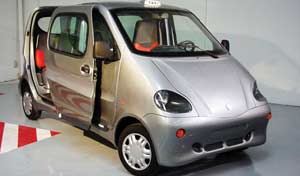
Tata Motors has signed an agreement with Moteur Development International (MDI) of France to develop a car that runs on compressed air, thus making travel very economical and totally pollution free.

Although there is no official word yet on the roll-out of the car, it is expected to be for commercially  will be commercially manufactured for India, reports say that it will be sooner than later.

The car, on the lines of the European MiniCAT, could cost around Rs350,000 in India and would have a range of around 300 km between refuels. The cost of a refill would be about Rs90.

MDI, which has carried out 10 years of research, is now ready to introduce its clean vehicles onto the market, reports said, adding, the compressed air technology allows vehicle engines to be both non-polluting and economical.

Unlike electric or hydrogen powered vehicles, MDI vehicles are not expensive and do not have a limited driving range. These cars are affordable and have a performance rate that stands up to current standards.


MDI has developed two technologies have been developed to meet different needs: single energy compressed air engines and dual energy compressed air plus fuel engines.

The single energy engines will be available in both MiniCATs and CityCATs. These engines have been conceived for city use, where the maximum speed is 50 km per hour.

The duel energy engine, which has been conceived for both the city and open roads, will will work exclusively with compressed air while it is running under 50 km per hour in urban areas. But when the car is used outside urban areas at speeds over 50 km per hour, the engines will switch to fuel mode. The engine will be able to use gasoline, gas oil, bio diesel, gas, liquidised gas, ecological fuel, alcohol, etc.

Both engines will be available with 2, 4 and 6 cylinders, When the air tanks are empty the driver will be able to switch to fuel mode, thanks to the car's on board computer.

The engine works on 90m3 of compressed air stored in fibre tanks 30 MPa (4500 psi). Carbon fibre is used to reduce the weight of the tank. The engine has injection similar to normal engines, but uses special crankshafts and pistons, which remain at top dead center for about 70 degrees of the crankshaft's cycle; this allows more power to be developed in the engine.

The expansion of this air pushes the pistons and creates movement. The atmospheric temperature is used to re-heat the engine and increase the road coverage. The air conditioning system makes use of the expelled cold air. Due to the absence of combustion and the fact there is no pollution, the oil change is only necessary every 50,000 km.

The light-weight vehicles can reach speeds up to 220 kmph. MDI's vehicle's have fibreglass bodies which makes them light. The car's body is tubular, light weight, and is held together using aerospace technology.

The vehicles do not have normal speed gauges. Instead, they will have a small computer screen that shows the speed and engine revolutions. The system allows for infinite possibilities such as GSM telephone systems, GPS satellite tracking systems, programmes for delivery people, emergency systems, internet connections, voice recognitions, map presentation, traffic information, etc.

The seatbelt system is also different. One part of the belt is anchored to the floor of the car, like traditional cars. The other part of the belt, in stead of being attached to the side of the car, is also anchored to the floor of the vehicle. This helps to secure the bodies of the driver and passengers in the case of a collision.

The vehicle's electric system is also revolutionary. MDI has bought a patent that is bound to reduce the important of electrical systems in all cars. The trick consists in using a small radio signal. The system makes the car 20 kg lighter and considerably quieter.

There are no keys - just an access card that can be read by the car from your pocket.

In the single energy mode MDI cars consume around Rs45 every 100 km.

When there is no combustion, there is no pollution. The vehicle's driving range is close to twice that of the most advanced electric cars (from 200 to 300 km or 8 hours of circulation).

The recharging of the car will be done at gas stations, once the market is developed. To fill the tanks it will take about to 2 to 3 minutes at a price of Rs90. After refilling the car will be ready to drive 200 kms.

The car also has a small compressor that can be connected to an electrical network (220V or 380V) and will recharged the tanks completely in 3 or 4 hours.

The temperature of the clean air coming through the exhaust pipe is between 0 and 15 degrees below zero and can be subsequently channeled and used for air conditioning in the interior of the car.

(See: Tata Motors, MDI of France sign technology pact)

View: Auto videos | Auto picture galleries


 search domain-b
  go
 
And now, a car that runs on air from the Tata stable