|
Chennai: India cleared a major milestone in its nuclear self-sufficiency programme, when the main vessel of the Prototype Fast Breeder Reactor (PFBR) at Kalpakkam was lowered inside a previously installed safety vessel and aligned. The PFBR is part of India's three-stage nuclear power programme and is expected to attain criticality in September 2010. 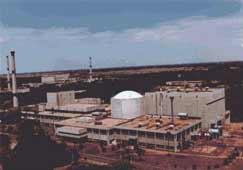 | | Fast Breeder Test Reactor at Kalpakkam | A release from Bharatiya Nabhikiya Vidyut Nigam Limited (BHAVINI), Kalpakkam, said the equipment which was lowered yesterday forms the heart of the reactor and was manufactured "to great precision." The 12.5-metre tall vessel with an equal diameter, made of special stainless steel alloy, ''forms the heart of the PFBR reactor," BHAVINI chairman and managing director SK Jain said. "This critical equipment was manufactured to great precision at the PFBR site itself," he said adding that with this, "PFBR has achieved a major milestone." India's first 500-MW Prototype Fast Breeder Reactor (PFBR) is being developed at the Indira Gandhi Centre for Atomic Research (IGCAR) at Kalpakkam, The vessel, weighing 206 tonnes, was moved from the assembly shop to the reactor site at noon on Friday and the installation was completed on Saturday morning. Scientists have said that the main vessel is the most critical component in the reactor and will hold the reactor fuel, grid plates and liquid sodium. With the installation of the main vessel, related civil construction will begin now. The PFBR will use plutonium-uranium oxide as fuel and liquid sodium as coolant. Eventually, pipelines would be erected and the coolant pipes filled with sodium before the reactor goes on stream. Scientists said that the PFBR system has been tested repeatedly, using nearly 1,000 tonnes of sodium in the process. They also clarified that all regulatory clearances have been obtained for installation of the components. A fast breeder reactor (FBR) is one that breeds more material than it consumes as part of the nuclear fission reaction chain. The Indian FBRs will use a blend of plutonium and uranium oxide as fuel. The huge advantage with a FBR is that surplus plutonium from each fast reactor can be used to set up more such reactors. The numbers can grow according to the nation's nuclear power generation programme. Earlier, on 23 June 2008, the reactor's safety vessel - into which the main vessel was lowered on Saturday - was installed. The safety vessel will prevent liquid sodium in the main vessel from coming in contact with the reactor vault. The safety vessel, made of special stainless steel, is 13.5 metres in diameter, 13.5 metres in height and 43 metres in circumference, and weighs 160 tonnes. It has been fabricated by Larsen & Toubro and meets world-class specifications. The 500-MW reactor is likely to go on stream in September 2010 and electricity generated from the reactor will be supplied to many states. According to scientists at the IGCAR, work is progressing on the design of six more fast breeder reactors. New FBRs New Fast Breeder Reactors are going to be modified versions of the prototype fast Breeder reactor (PBFR) coming up at Kalpakkam. The proposed reactors are going to be different in many ways from the prototype fast breeder reactor (PFBR), IGCAR scientists have said. These reactors will be designed to last 60 years, 20 more than the PFBR's life span. The reactors are also being designed to be operable in sync with similar reactors at the same site. These synergies will result in huge cost savings and be responsible for bringing per unit cost of electricity down to Rs2, as compared to Rs3.20 per unit from the PFBR. The FBRs will be built as twin units, allowing the sharing of facilities by two reactors. This would result in saving capital and running costs. With fewer welding points, for instance, it would also make the reactors safer and more economical. The safety vessel of the proposed reactors will be smaller than the one installed inside the PFBR's reactor vault, with its diameter reduced to 11.5 metres from 12.9 metres. Per metre reduction will result in an overall saving of Rs25 crore on material, fabrication and civil construction. The new design will have six steam generators, as against eight in the PFBR, and changes will also be made in the grid plate, sodium and reactor shutdown systems. Scientists emphasised that design changes in the proposed reactors did not mean that the PFBR was over-designed, but just that the proposed changes would be less conservative. Scientists are also confident that new projects could be completed in five years, as against seven years, because of the experience gained from setting up the PFBR.
|


