|
 Hampi, the capital of the famed Vijayanagara Empire reached its pinnacle during the reign of emperor Krishnadevaraya. Stretching across the present states of Karnataka, Maharashtra and Andhra Pradesh, Hampi has imprinted its name in gold on the pages of history. Two Hindu princes, Harihara and Bukkaraya, founded the empire in 1336 AD. Hampi, the glorious capital that once boasted of fame far beyond Indian shores, was laid waste by Mughal marauders. Its present is but a shadow of its bygone past; every single rock in the place seems to plaintively reflect its erstwhile glory and grandeur. Hampi, the capital of the famed Vijayanagara Empire reached its pinnacle during the reign of emperor Krishnadevaraya. Stretching across the present states of Karnataka, Maharashtra and Andhra Pradesh, Hampi has imprinted its name in gold on the pages of history. Two Hindu princes, Harihara and Bukkaraya, founded the empire in 1336 AD. Hampi, the glorious capital that once boasted of fame far beyond Indian shores, was laid waste by Mughal marauders. Its present is but a shadow of its bygone past; every single rock in the place seems to plaintively reflect its erstwhile glory and grandeur.
| Did you know? The Vijayanagara Empire was the last great Hindu kingdom of India. Its rulers were renowned for their military achievements and as upholders of Hindu art, music and literature. The emperors were famed for religious tolerance, political maturity and patronage of cultural monuments. Many clues have been uncovered indicating that Vijayanagara was an empire before its time. An indication of the far-sightedness of the kings was the fact that they established close ties with empires outside the peninsula. There is evidence of trade routes with China and diplomatic trade links with Persia, Portugal, Italy and Russia. | Built of massive stone and earthen walls, Vijayanagara city was a fortress with watchtowers scattered across its length and breadth that provided maximum visibility. From the days I read about the great Vijayanagara Empire in history books, I nursed a secret desire to visit this historic site. It is only recently that I achieved that aim. Three of my colleagues and I decided to visit Hampi during the Diwali vacations. We took an overnight train from Mumbai to Guntakal station, and went onwards by bus to Hampi via Hospet. This was the most painful 4-hour part of the trip, as we were travelling on non-existent roads, in a bus lacking shock absorbers. However, Hampi is more than worth the pain of getting there. We arrived at Hampi around 10 in the morning and unpacked at the Siddhartha Residency hotel. On first stepping out into the city, we came to Mango tree, a conceptual eatery, and devoured a scrumptious brunch. We had a great view of the valley, river and ruins. The food and the ambience were both refreshing. It was a pleasure to leave tables, chairs, spoons and forks far behind, and to actually squat to eat traditional fare. After our pet puja, we began our exploration of Hampi. 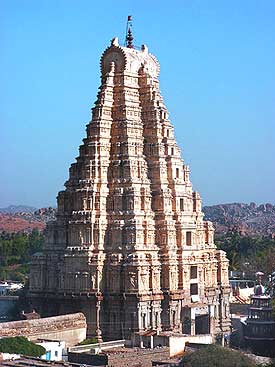 The temples of Hampi are famous for their large dimensions, florid ornamentation in painting and carving, majestic pillars, magnificent pavilions and a great wealth of religious and mythological depictions, including subjects from the Ramayana and the Mahabharata. The Hampi Bazaar, a street 32 metres wide and nearly 728 metres long, between Virupaksha temple and the foot of the Matanga Hills, was once lined with magnificent houses and beautiful mandapas. The 15th century Virupaksha temple, the oldest in Hampi, is dominated by its 50 metre tall gopuram. The sculptures atop the tower reflect the local worship of the deities, Shiva, Pampa, and Bhuvaneswari. The temples of Hampi are famous for their large dimensions, florid ornamentation in painting and carving, majestic pillars, magnificent pavilions and a great wealth of religious and mythological depictions, including subjects from the Ramayana and the Mahabharata. The Hampi Bazaar, a street 32 metres wide and nearly 728 metres long, between Virupaksha temple and the foot of the Matanga Hills, was once lined with magnificent houses and beautiful mandapas. The 15th century Virupaksha temple, the oldest in Hampi, is dominated by its 50 metre tall gopuram. The sculptures atop the tower reflect the local worship of the deities, Shiva, Pampa, and Bhuvaneswari.
We walked to the Royal Centre ruins and saw the Queen's Bath, Lotus Mahal, the Zenana enclosure, the underground Virupaksha temple and elephant stables before heading back along the road and stopping at the Krishna temple, monolithic Ganesh and Hemakuta hills. The temples carved in infinite detail amongst the giant boulders were truly amazing. The only place, which charges an entry fee, is the Royal Enclosure with the Lotus Mahal. The Vithala temple with its chariot bears semblance to the famous Konark temple of Orissa. We walked back into town to have a drink, and then continued to the Sule Bazaar and the Achyutaraya Temple. We also saw a coracle crossing to Anegondi. There are three places in Hampi where you will see coracle crossings. Coracles are huge basketlike boats that ferry people and sheep. About 6 feet in diameter, they are made of bamboo, cane, plastic sheets and a fine coating of bitumen to prevent leaks. A coracle ferries about six to eight people at a time. However, this is not for the weak-hearted. 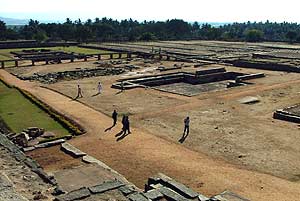 Tourists spend many days in Hampi, looking at the sculptures, and the rocks in differing light. The rocks seem to be different at sunrise and sunset, while the light throws the sculptures into perfect silhouettes. We returned to our rooms for a quick nap before heading back out to watch the sunset. Tourists spend many days in Hampi, looking at the sculptures, and the rocks in differing light. The rocks seem to be different at sunrise and sunset, while the light throws the sculptures into perfect silhouettes. We returned to our rooms for a quick nap before heading back out to watch the sunset.
We then went to the Ranga Temple, which is in ruins. Back on the main road, the 6.7 metre tall monolithic statue of Laxmi Narasimha held us spellbound. We also visited the Badavlinga Temple to see the massive Shiva Linga. We retired after a great dinner at Purple Grass, Siddhartha Residency.
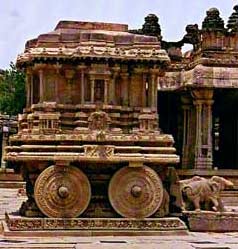
The next day, we visited the most famous and arguably the most resplendent of Hampi temples, the Vittala temple. Fifty-six ornate, superbly carved monolithic pillars, dubbed the musical pillars, dominate this temple. When tapped, each one emits different musical notes. Towards the east is the famous Stone Chariot, depicting an elephant pulling a chariot. A feat of exquisite engineering, its wheels actually rotate. The House of Victory built when Krishnadeva Raya came back from his victorious expedition against the King of Orissa is notable for its elaborate and elegant carvings. The kings of Vijayanagara witnessed the nine–day Dussehra festival from a grand throne in the House of Victory. The so-called King's Balance is an unusual piece. Legend has it that the wealthy kings were weighed against grain or gold on the giant scale, which was later distributed to the poor. 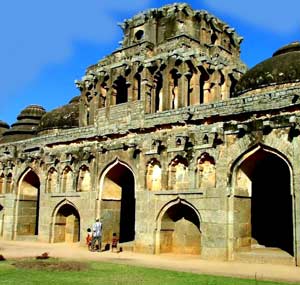 Its present aridity is far removed from the once fertile pastures of the erstwhile Vijayanagara Empire. Innovative irrigation methods helped achieve self-sufficiency in food. Numerous canals provided a perennial water supply to the narrow strip of fertile land bordering the Tungabhadra River. Many of these canals are still in use today though they have been modified to meet current requirements. Its present aridity is far removed from the once fertile pastures of the erstwhile Vijayanagara Empire. Innovative irrigation methods helped achieve self-sufficiency in food. Numerous canals provided a perennial water supply to the narrow strip of fertile land bordering the Tungabhadra River. Many of these canals are still in use today though they have been modified to meet current requirements.
The next site on our minds was the Tungabhadra Dam about 6kms from Hospet. The reservoir, filled to capacity, had all its gates open, and spilled out massive amounts water gushing with raw force. This magnificent sight makes you feel really small and insignificant. A trip to Hampi is like stepping into another world, and it is impossible to detach oneself from its charm. I came, I saw, and it conquered my heart and my memory.
|


