|
A loud rattling call from a nearby treetop announced its presence. I scanned the tall trees, catching a glimpse of the animal’s torso before I saw its bushy tail. The animal was perched on top of a high branch, busily building what looked like a nest of twigs and leaves. It was the Giant Indian Squirrel, the most elusive animal at the Bhimashankar wildlife sanctuary. 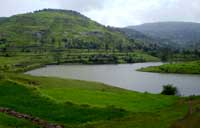 My journey in search of the shekru (squirrel in marathi) started from the bustle of Pune city, and continued with a pleasant ride along the highway. Passing numerous villages on the way, the journey continued amidst the breathtaking beauty of the higher roads of the ghats. My journey in search of the shekru (squirrel in marathi) started from the bustle of Pune city, and continued with a pleasant ride along the highway. Passing numerous villages on the way, the journey continued amidst the breathtaking beauty of the higher roads of the ghats.
My ride ended at Bhavgiri, a village situated on the outskirts of the sanctuary, situated on top of the range. The Western Ghats, surrounded by a canopy of dense forest, were truly magnificent. Ahead in the village, right on the edge of the forest, stood the Bhimashankar temple, a famous shrine dedicated to Lord Shiva. According to visitors, trekking through the dense forest is the best way to enjoy the Bhimashankar Sanctuary. I found a guide from the village, who agreed to escort me into the sanctuary for a small fee. It was the month of August and the entire forest was wet and green due to the constant rain. A rocky road behind the temple proved to be the gateway to the forest. The forest’s natural beauty was bedecked with a number of streams and small waterfalls formed by the monsoon showers. It was drizzling, and the jungle was alive with the sounds of insects and birdcalls from all directions. I spotted a jungle fowl, a part of the pheasant family commonly found in the jungles of India, scurrying into the bushes. Walking ahead, we found fresh animal tracks, which on closer inspection proved that of a deer. However, the animal was nowhere to be seen.  I seem to posses an irresistible attraction to mud. If there was only one dab of mud to be found in the whole of Mumbai city, I am sure it would be on me! The mud surface of the sanctuary, soft and soggy in the rain, proved it was no exception to my allure. I had mud baths on two occasions. I seem to posses an irresistible attraction to mud. If there was only one dab of mud to be found in the whole of Mumbai city, I am sure it would be on me! The mud surface of the sanctuary, soft and soggy in the rain, proved it was no exception to my allure. I had mud baths on two occasions.
Soon, I had my third fall of the day. It looked like a walk in the park when we had to cross a small stream to get to the other side. Sadly, though, the projected smooth walk across the watercourse was cut short thanks to the slippery rocks beneath. A three-four second vigorous balancing act did not save me from perfect disgrace, much to the amusement of my guide. Fortunately, for me, there were no injuries, other than a few minor bruises. Best of all, the fall had washed away the mud, well, most of it. My stunts at Bhimashankar should be a learning experience for people planning to visit the sanctuary. Following simple rules will ensure an injury free trip for the visitors. Safety Instructions - People visiting the sanctuary, especially during the monsoon season should wear shoes, which have a good grip over slippery surfaces. Or else get on your dancing shoes.
- First-time visitors are advised to enter the sanctuary with a guide.
- Alternatively, notify the forest authorities in advance, if you are planning to set out on a solo adventure.
- Visitors should carry a first aid box.
- Carry plenty of water as the treks are long and one can easily get dehydrated.
- A five to six hour walk in the forest can make people extremely hungry. Since hunting is illegal, it is advisable to carry dry snacks like biscuits and chocolate bars.
As we walked through the forest, I looked around, hopeful of sighting more animals. Sighting animals in the wet weather is almost impossible. I managed to see a hornbill, carrying on with its daily activity of carving trees. We saw a few birds safely sheltered among the high branches of the trees. Occasional monkey calls could be heard; however, there was no sign of the shekru. Then I heard it! The rattling call was unmistakable, and I knew the shekru was close by. Finally, after squinting at the treetops, I zeroed-in on the squirrel, which was perched safely on top of a tree. I was mesmerised by the beauty of the animal and stood still admiring the rare shekru. It did not take me long to understand why the giant squirrel was reputed to be one of those blink-and-you-miss-it kind. With my eyes firmly fixed on it, I inched closer, all set to capture the rare animal on camera. But, alas! I stepped on a dry branch, and the crack that ensued echoed through the forest like gunshot. The shekru was gone, and my guide had taken cover among the bushes. The shekru remained elusive for the rest of my trip but I was satisfied with the entire day’s events. It was rewarding, as I was lucky enough to spot a few other animals. The captivating beauty of the green hills, the fresh air and the blissful forest ambience left a lasting impression on me. Bhimashankar is the perfect place to get away from the crowd, dust and noise of the cities. The sanctuary
Located in the Ambegaon Taluka of Pune District, at an altitude of 2,200 feet to 3,800 feet, the Bhimashankar wildlife sanctuary runs across the three districts of Pune, Raigad and Thane. The 120 sq kms of dense forest surrounding the sanctuary is home to a wide variety of animal species such as the leopard, Sambar, Barking Deer, wild pig, langur, rhesus macaque, pangolin and the Giant Indian Squirrel. The sanctuary also has a large avian population with the Quaker Babbler, the Malabar Grey Hornbill, the Green Pigeon, the Malabar Whistling Thrush, the Black Eagle, the Grey Jungle Fowl and many more species making their home in the sylvan surroundings. Shekru
The shekru is an arboreal animal, which lives on tree-tops in dense forest surroundings. The tall trees in Bhimashankar is an ideal dwelling for the squirrel. The shekru can reach up to 3 feet in length during adulthood. Its strong bushy tail, that measures up to 2 feet is mainly used for balance, which helps the squirrel move through the trees without falling.The squirrel is a herbivorous animal and feeds mainly on fruits. 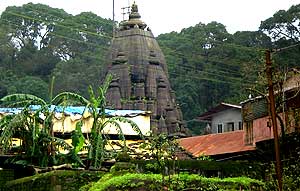 Bhimashankar temple Bhimashankar temple
Bhimashankar temple, dedicated to Lord Shiva, is one of the 12 Jyotirlingas in India. Bhimashankar is also the source of the river Bhima, which flows southeast and merges with the river Krishna near Raichur. Legends about the origin of the place abound. According to one legend, Lord Shiva also known as Shankara, fought Tripurasura and killed him. It is believed that the sweat that poured from Shiva’s body after the battle formed Bhima River. Another legend places the demon Bhima, son of Kumbhakarna, Ravana’s brother as Shiva’s opponent. After killing the demon, Lord Shiva (Shankara) agreed to stay on as the principal deity of the place – hence the name Bhimashankar.
How to get there
Driving down from Pune or Mumbai, is the best way to reach Bhimashankar. It is located 110 km away from Pune, which is a good four to five hour drive. From Mumbai, the sanctuary is around 260 kms and takes seven to eight hours by car. If you want to enjoy the scenic beauty and view the rich flora and fauna, visit the place for at least two to three days. The best time to visit is from October through May, but the monsoons can also be the most romantic time to enjoy the magic of the wilderness.
|


