|
I was wrapped in a warm blanket…but as I opened the first page, sleep would soon vanish from my eyes. It was between 1975 and 1979 that almost 25 percent of Cambodia's population was systematically cleansed or succumbed to one of the worst genocides of modern times brought on by Saloth Sar aka Pol Pot. Saloth Sar was born a peasant but brought up in the corridors of Cambodian royalty's palace courtesy his sister, one of the many concubines of King Monivong. 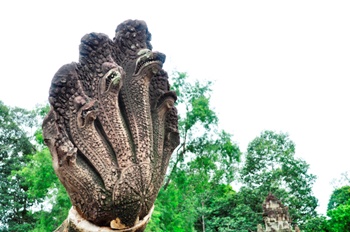 And that coincidence brought with it the many privileges: an education at the elite Lycee Sisowath (Colonial French School) and a technical scholarship to a Paris bustling with an underground Communist movement. When Sar returned, he came back as Pol Pot, an impressionable young man with misinformed ideas of nationalism and communism, to a Cambodia in the throes of conflict. A World War depleted France was rapidly withdrawing from Indochina and Cambodia hurtled towards a monarchical independence. Added to the mix were the territorial ambitions of the Viet Minh and violent communist movements supported by China. And that coincidence brought with it the many privileges: an education at the elite Lycee Sisowath (Colonial French School) and a technical scholarship to a Paris bustling with an underground Communist movement. When Sar returned, he came back as Pol Pot, an impressionable young man with misinformed ideas of nationalism and communism, to a Cambodia in the throes of conflict. A World War depleted France was rapidly withdrawing from Indochina and Cambodia hurtled towards a monarchical independence. Added to the mix were the territorial ambitions of the Viet Minh and violent communist movements supported by China.
And somehow, caught between all of this, a perennial underperformer with a peasant background would become Angkar: the invisible lord of the Khmer Rouge, one of the deadliest despots of all times. Pol Pot killed millions of people. His interpretation of the communist ideal was an absolute retreat from the peasant lifestyle. And therefore, anyone having any connection to elitism, culture, education, sciences would be summoned by Angkar, never to return: teachers, doctors, managers, scientists, classical dancers, musicians…everyone. I woke next day with a newfound empathy for Tan. And many other nameless faces I had crossed on the streets. The smirk that appeared on my face the day before on how any and every one had tried to manipulate the name Angkor for commercial success had disappeared. What other choice did the country have other than to cling to the only connection to a forgotten glory? The hotels in Siem Reap understand your need for carbohydrates in the morning. Because if you need to walk miles (and miles), climb the uneven steps of the temples of Angkor and rush back in time to witness the sunset from the top of the prime Wat, you need to tuck in. The lavish breakfast spread at Somadevi Angkor helped us prepare sufficiently for a bright and early start. Tan, our driver from Poipet had agreed to send his brother as our driver and guide for the day. And in a short while, passes to the park bought and punched, there we were, in the huge all-encompassing arms of Angkor. 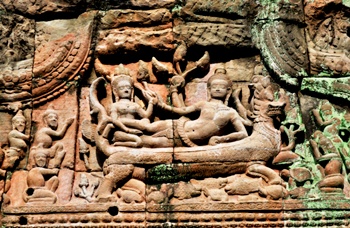 Myths immortalised in stone Myths immortalised in stone
The old Hindu myth goes like this. In the everlasting tussle for power between good and evil, following a curse, Hindu lords of heaven, the Devas had lost the heavens to Asuras or the balancing evil spirits. It was then that the wily Lord Vishnu, operator of the world came up with the idea of churning the mighty seas (Sagar Manthan). The churning would bring to fore the largesse from the oceans. Amongst them would be elixir of life, a promise of eternal life to both the Devas and the Asuras. The catch? Either could not do it alone. The mighty Mt Meru would serve as the churning rod and the great king of serpents, Vasuki as the rope. Both Devas and Asuras agreed. And when the elixir finally did appear, Lord Vishnu, donning the form of a beautiful woman, charmed the Asuras away, leaving the Devas to have the elixir all to themselves.
If you are born a Hindu, the adaptation of the fables first strike you when you see the familiar form of Devas and Asuras holding a serpentine rope on either side of the entrance of the great Angkor Wat. The moat that surrounds the square Wat has four such entrances bridging over it, one on each side, each entrance sporting similar forms. Directly ahead, dead straight is the central dome of the Wat. You begin to walk in…and that's when it hits you! Angkor Wat was a temple dedicated to Lord Vishnu. And the ancient Khmer chose that particular myth, that monumental moment in divine history which forever established the superiority of good over evil. The Angkor Wat is a living model of the churning of the great seas. The Wat itself represents Mt Meru, the moat around it, the great seas and the bridges across playing Vasuki. In that moment of realisation…what was till moments before a mere building in stone came alive for me. The sheer imagination of the great architects immortalised their beliefs in such an indestructible way that nature and its strongest elements took control of the temple for hundreds of years and failed to erase them. So indestructible that even 1,000 years after a change of faith replaced the Hindu deity from the main chamber of the temple, every part of the temple still scream their intended stories in endless bas reliefs carved into stone. So indestructible, that the temples of Angkor remain the thin strand of roots, that connects this fragile country to its glorious past even after the Khmer Rouge attempted to wipe it off with the blood of six million innocent Khmers. Little did I know, that my wonder for this small dot of a nation on the massive Asian continent would continue to grow till the end of my journey? 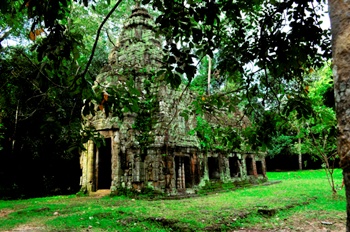 So grand is the scale of Angkor that the three days we had there were woefully inadequate, only enough to visit the important temples which include Baphuon, Preah Khan, Bantey Srei and Bayon apart from the Wat itself. But the more we saw, the more we got lost in these stories painted in stone. Deriving childlike joy in decoding the familiar fables in unfamiliar faces, we went from temple to temple. And when we finally turned on our heels as the sun set in the distance on the last day of our trip, exhausted but content, fulfilled but hungry for more, the characteristic smile on Tan's face betrayed just slight amusement. So grand is the scale of Angkor that the three days we had there were woefully inadequate, only enough to visit the important temples which include Baphuon, Preah Khan, Bantey Srei and Bayon apart from the Wat itself. But the more we saw, the more we got lost in these stories painted in stone. Deriving childlike joy in decoding the familiar fables in unfamiliar faces, we went from temple to temple. And when we finally turned on our heels as the sun set in the distance on the last day of our trip, exhausted but content, fulfilled but hungry for more, the characteristic smile on Tan's face betrayed just slight amusement.
Siem Reap town and the sight of its cars and ugly resort buildings with overdone facades was like a jolt of rude reality and we quickly sought refuge in the swimming pool of our hotel. When the water had adequately infused us with enough energy to survive one more night of wandering about, we hit the streets. Beside the Angkor night market, which sells exotic perfumes and clothes woven with stunningly soft cotton along with its many trinkets, tucked in, there is a square where every night bicycle-carts driven by traditionally dressed Khmers assemble. Within minutes of the sun setting, the square quickly transforms from being part of the road to an eat-street. The aromas (or smells, depending on your food persuasion and palate) waft through the street promising exotic wonders of a relatively unknown cuisine. And in food to, the history of this puny nation trumps all. Khmer cuisine is also one of the world's most ancient cuisines and celebrates simplicity to prove it. The balance of flavours and respect for natural ingredients shine through. But like any other Asian nation, it is not for those with a set palate. And then…we hit pub-street. Click to read Part 1: Angkor Wat: the city of sleeping gods Click to read Part 3: Taking leave of Angkor Wat
|


