|
Kolkata: Assigned overall responsibility for maritime security, including coastal and offshore defence after the Mumbai attacks, the Indian Navy has now inducted two Water Jet propelled Fast Attack Craft (WJ-FACs) into operational service in order to better deal with asymmetric threats. The ability of these new WJ-FACs to operate in shallow waters and at high speeds, their day-night surveillance capability as well as enhanced fire power is expected to provide the needed capability for dealing with sea-based threats such as that experienced during the 26/11 Mumbai attacks. 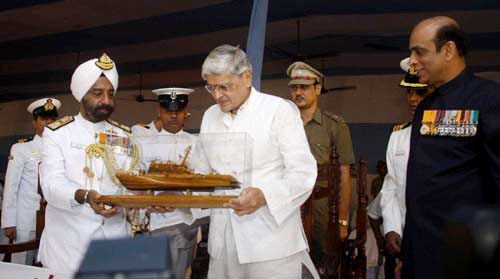 | | The Governor of West Bengal, Shri Gopal Krishna Gandhi receiving a model of the ship from Vice Admiral Anup Singh of Indian Navy which he commissioned at Kolkata | Two of these craft, the INS Cora Divh and INS Cheriyam, were commissioned by West Bengal Governor Gopalkrishna Gandhi at a colourful ceremony. The ships are number three and four of a new series of ten WJ-FACs designed and built by Garden Reach Shipbuilders and Engineers Ltd (GRSE). The first two boats of the class, INS Car Nicobar and INS Chetlat, were commissioned in February of this year. This new class of boats are intended to replace the earlier Seaward Defence Boats (SDBs). Named after the pristine islands located in the Lakshadweep chain, INS Cheriyam and INS Cora Divh, are commanded by commander Sudip Malik, and commander N Hariharan respectively, both specialists in gunnery and missiles. The two vessels commissioned on Thursday will be stationed in Chennai. "These vessels, with more than 90% indigenous components, are comparable with the best in the world. They can traverse at 35 knots (65 km per hour) and are highly potent. We hope to hand over two more WJFACs by December. We have already delivered 13 fast patrol boats for coastal security. In February, 2010, we also hope the launch the first anti-submarine warfare (ASW) corvette," said rear admiral KC Sekhar, chairman cum managing director, GRSE. Though ordered in 2006, the need for such vessels was acutely felt after the 26/11 attack on Mumbai. "These powerful systems that can operate in shallow waters. GRSE succeeded in completing these vessels in 22 months. The next two will take 20 months to build. The remaining four will be completed in 18 months. This proves that GRSE has mastered modular construction of such craft," Adm Singh said. The ships measuring close to 50 meters in length and displacing 325 tons, can achieve speeds in excess of 30 knots. Meanwhile, the Indian Navy on Monday de-commissioned two of its Seaward Defence Boats, T-59 and T-60, 24 years after they were first commissioned. The decommissioning took place at the Madras Port Trust in the presence of commodore Rajiv Girotra, VSM, naval officer-in-charge, Tamil Nadu & Puducherry, who received the guard of honour. These ships are to be replaced by the two new WJ-FACs. The paying off pennant was hoisted on Sunday to mark the beginning of the decommissioning ceremony. WJ-FACS
The vessels don't have rudders or propellers and can operate at a draught of merely two metres. The boats are armed with CRN-91 automatic cannon that can engage targets up to 3 kilometres away. The guns are controlled by fire control radar. The boats will also carry a complement of IGLA shoulder-mounted surface-to-air missiles. The 10 Car Nicobar class WJ-FACs, with their ability to react quickly at high speeds, are purpose designed for coastal security. These 50 metres long, 325-tonne vessels have a complement of 35 sailors. GRSE, India's second-biggest defence shipyard after Mazgaon Docks Ltd (MDL), got an Rs514-crore order in March 2006 for the construction of 10 WJ-FACs, powered by German MTU water-jet engines. These boats were intended to slice through water at speeds of 65 kmph and can patrol 3,600 km without refuelling.
|


