|
Islamabad: The possibility that India may extend valuable financial aid to Kabul to construct a series of hydro-power projects on the Kabul River has left the Pakistani establishment deeply rattled. It now appears that India may well have opened a new front in the strategic game being played out in the region even as Chinese army (PLA) presence in Pakistan-occupied –Kashmir (PoK) is now a confirmed fact. The PLA presence ostensibly, as explained away by Pakistan, is necessary to execute ''engineering'' projects. News is now filtering out that India may extend financial aid, perhaps even technical, to the beleaguered government of Afghanistan to build 12 hydro-power projects on the Kabul River. India's own hydro projects on the rivers Indus, Jhelum and Chenab are already a bone of contention between these two warring neighbours as they originate in India but flow into Pakistan. 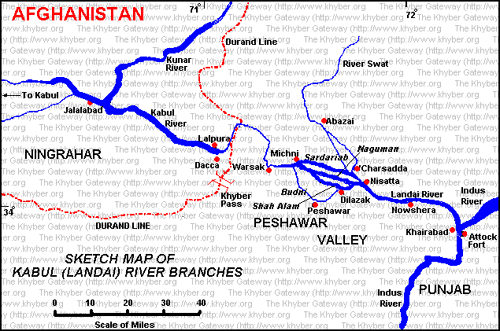
The 12 dams on the Kabul River will involve building a total water storage capacity of 4.7 million acre feet (MAF), which, as worried Pakistani experts point out, will be 25% more than their own massive Mangla Dam. Pakistani sources claim that Kabul is initiating multi-purpose water projects on the tributaries of the Kabul River with assistance from the international community and that India plans to assist Afghanistan in this initiative. The Pakistani establishment is of the opinion that these projects are likely to adversely impact Pakistan. According to Pakistani estimates it is likely that the World Bank will fund the $7.079 billion cost of the 12 dams. Details, as revealed by Pakistani sources, suggest that four hydropower projects are likely to come up in the Panjshir sub-basin. These would include the $332 million Totumdara project, designed to generate 200 MW of electricity; a $1.174 billion Barak project which will generate 100 MW of electricity; a $1.078 billion Panjshir (100 MW) project; and the $607 million Baghdara (210 MW) project.  The Logur Upper Kabul sub-basin on the Kabul River will see construction of four more dams, including the $72 million Haijana project (72 MW); the $207 million Kajab (15 MW) project; the $356 million Tangi Wadag (56 MW) project and the $51million Gat (86 MW) project. The Logur Upper Kabul sub-basin on the Kabul River will see construction of four more dams, including the $72 million Haijana project (72 MW); the $207 million Kajab (15 MW) project; the $356 million Tangi Wadag (56 MW) project and the $51million Gat (86 MW) project.
Four more dams will be built in the Lower Kabul sub-basin, including the $442 million Sarobi project (210 MW); the $1.434 billion Laghman project (1251 MW) and the $1.094 billion Kunar (A) (94.8 MW) and Kama projects (11.5 MW). According to Pakistan-supplied statistics, Afghanistan and Pakistan currently share nine rivers with annual flows of about 18.3 million acres feet (MAF), of which Kabul River alone accounts for 16.5 MAF. The River Chitral, which originates from Pakistan, contributes about 8.5 MAF. After it enters Afghanistan the Chitral is called the River Kunar. It joins the Kabul River near Jalalabad and then re-enters Pakistan. Paksiatni sources suggest that atleast 0.5 MAF water from these planned dams will be taken away to irrigate additional 14,000 acres of land in Afghanistan. Pakistani experts are now pointing out that though Afghanistan has the right to utilise water from the Kabul River it should keep in mind that the Kunar River is a major contributor to the total water flows of the River Kabul. Though the total flow of the Kabul River is 21,000 Million Cubic Meter, Pakistani sources aver that the River Kunar alone contributes 15,000 Million Cubic Meter to that flow. The Kunar, it is being pointed out originates in Pakistan. If these projects should fructify, the Pakistanis are openly voicing concerns that they may have to purchase their electricity from Afghanistan, which they claim is the underlying purpose of the Indian exercise.
|


