|
New Delhi: The Government of India's cabinet committee on security (CCS) is understood to have taken up the induction of the indigenously-produced and developed Akash surface-to-air missile defence system into the Indian Army. The Indian armed forces are going in for large scale induction and deployment of the indigenous Akash short range surface-to-air missile (SR-SAM) on both the western and eastern fronts of the country's borders. 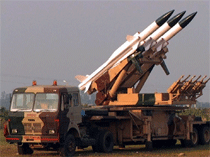 It is understood that the Indian Army will now place orders for two regiments of the missile system, which has already been inducted into the Indian Air Force (IAF). It is understood that the Indian Army will now place orders for two regiments of the missile system, which has already been inducted into the Indian Air Force (IAF).
The IAF has already inducted two squadrons of the missile system and is looking to place orders for another six. Six of IAF's squadrons will be based in the country's north east to counter China. They will be procured at a cost of Rs6,200 crore. The CCS on Thursday cleared two Akash regiments, with six batteries and hundreds of missiles each, for the Indian Army. The total order for the Army stands at Rs14,180 crore at present. The 'regiment' is the army equivalent of an IAF squadron. The low-reaction-time Akash is designed to neutralise multiple aerial targets attacking from several directions simultaneously, with a digitally-coded command guidance system, in all weather conditions. DRDO sources say the 5.6-metre-long Akash can even take on sub-sonic cruise missiles, which is a useful potential given the fact that arsenals of both hostile neighbours Pakistan to the west and China to the north are equipped with ripped-off versions of the American Tomahawk. The Akash induction will help the Indian armed services to replace obsolete Russian-origin Pechora and OSA-AK missile systems. The Akash short range surface-to-air missile (SR-SAM) Akash is a surface-to-air missile with an intercept range of 30 km. It flies at supersonic speed, reaching around Mach 2.5, and can reach an altitude of 18 km. It is capable of being fired from both tracked and wheeled platforms. An on-board guidance system coupled with an actuator system makes the missile manoeuvrable up to 15g loads and a tail chase capability for end game engagement. A digital proximity fuse is coupled with a 55 kg pre-fragmented warhead. The use of a ramjet propulsion system enables sustained speeds without deceleration throughout its flight. The missile has command guidance in its entire flight. The design of the missile is somewhat similar to that of the SA-6 with four long tube ramjet inlet ducts mounted mid-body between wings. Each Akash battery consists of four self-propelled launchers (three Akash SAMs each), a Battery Level Radar - the 'Rajendra', and a command post (Battery Control Centre). Two batteries are deployed as a Squadron (Indian Air Force), while up to four form an Akash Group (Indian Army configuration). Up to a maximum of four targets can be engaged by a typical battery with a single Rajendra if one missile is allotted per target. The missile is guided by a phased array fire control radar called 'Rajendra' which is termed as Battery Level Radar (BLR) with a tracking range of about 60 km. It can track 64 targets in range, azimuth and height and guide eight missiles simultaneously towards four targets. The Rajendra derivative on a BMP-2 chassis and to be used by the Indian Air Force is known as the Battery Level Radar-II whereas that for the Army, is based on a T-72 chassis and is known as the Battery Level Radar-III. A single Akash missile has an 88% 'probability of kill'. Two missiles can be fired, five seconds apart, to raise the 'probability of kill' to 98.5%. Long range target acquisition is performed by the 3D Central Acquisition Radar (3D CAR), which is a long range surveillance radar that can track 150 targets in Track while Scan mode at a range of 180 km. The Akash, like the Russian 2K12 Kub (SA-6 Gainful), utilizes an integrated ramjet-rocket propulsion system, which provides thrust for the missile throughout its entire flight. The engine is 'on' throughout the flight. The thrust is on till the missile intercepts the target. Each missile is expected to have starting costs below $500,000, which is less than half the cost of similar Western missiles which usually cost between $1.2-1.5 million. It is expected that this cost will further decrease due to the economies of scale achieved as production ramps up. In May 2008, the Indian Air Force decided to induct two squadrons (totalling 36 batteries) of Akash missile. In March 2009, Tata Power's Strategic Electronics Division (Tata Power SED) announced that it had bagged an order for 16 Akash launchers to be delivered in the next 33 months. In January 2010, it was revealed that the Indian Air Force had placed orders for 6 more squadrons. Each squadron would consist of 125 missiles, bringing the order to 750 missiles. The first two squadrons will consist of 48 launchers each while future squadrons will vary in number depending on the IAF. The additional missiles were ordered from state-run defence behemoth Bharat Electronics Ltd (BEL). The total Indian Air Force orders thus far consist of eight squadrons making a total of 1000 missiles.
|


