|
Bangalore: Reflecting the diversity of the research and development work undertaken by the country's Defence and Research Development Organisation (DRDO), it has been announced that work will soon start on developing an indigenous unmanned combat aerial vehicle (UCAV) which will not only do surveillance work, but also detect and destroy hostile targets. 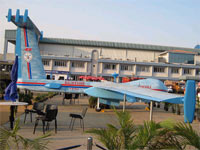 "We will soon embark on designing and developing an unmanned combat aerial vehicle, which will not only do surveillance, but will also help detect the target and destroy the identified object," VK Saraswat, director general, DRDO and scientific advisor to the defence minister said. "We will soon embark on designing and developing an unmanned combat aerial vehicle, which will not only do surveillance, but will also help detect the target and destroy the identified object," VK Saraswat, director general, DRDO and scientific advisor to the defence minister said.
An UCAV differs from ordinary UAVs in that it also attacks the targets that it surveys. The project will be taken up by the Aeronautical Development Establishment (ADE) laboratory in Bangalore and will also involve private industry participation. "The controls of a combat drone will be rested with multiple command control centres. The centres can be geographically at different locations. Even if one centre becomes defunct, the drone can be controlled and guided by other centres," Saraswat said. He was speaking on the margins of the fifth national conference on 'NextGen IT for Indian Defence'. "The UCAV will work in a multi-layer manner for which ADE is developing the required technology, including sensors," Saraswat said. From earlier information supplied by the DRDO, it is clear that the programme will involve developing the know-how for a stealth design and composite construction technical demonstrator that will demonstrate ''the technical feasibility, military utility and operational value for a networked system of high performance'' weaponised UCAVs. Earlier, disclosing aspects of the programme, the DRDO's chief controller, research and development (aeronautics and material sciences), D Banerjee, had said that with ''stealth obviously be an important issue'' the fuselage would have to carry internally housed weapon bays. Stealth would also require the power plant to be internally mounted and of a non-afterburning turbofan engine type. The ADE is already developing a medium altitude long endurance unmanned aerial vehicle (MALE UAV) codenamed 'Rustom' for the three Indian defence services - army, air force and navy. The first prototype, developed by Taneja Aerospace and Aviation Ltd, crashed on 16 November at Hosur in Krishnagiri district of western Tamil Nadu, about 40 km from here. The Rustum UAV, with a wingspan of 20 metres and weighing 1,800 kg, has a maximum speed of 225 km per hour and can operate at an altitude of 30,000 feet. "The Rustom UAV will be able to execute surveillance of enemy territory up to a distance of 250 km and carry a variety of cameras and radar for surveillance," Saraswat said. DRDO officials said the crash of the remote-controlled Rustom took place because of faults in the remote control apparatus.
|


