NIST’s second Quantum Logic Clock based on aluminum ion is now world’s most precise clock
06 Feb 2010
Physicists at the National Institute of Standards and Technology (NIST) have built an enhanced version of an experimental atomic clock based on a single aluminum atom that is now the world's most precise clock, more than twice as precise as the previous pacesetter based on a mercury atom.
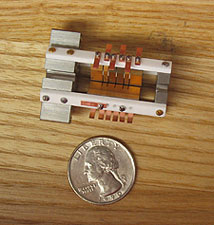 |
| The ion trap where the main action takes place in the NIST aluminum ion clock. The aluminum ion and partner magnesium ion sit in the slit running down the center of the device between the electrodes. Credit: J. Koelemeij/NIST |
The new clock is the second version of NIST's ''quantum logic clock,'' so called because it borrows the logical processing used for atoms storing data in experimental quantum computing, another major focus of the same NIST research group.
''This paper is a milestone for atomic clocks'' for a number of reasons, says NIST postdoctoral researcher James Chou, who developed most of the improvements.
In addition to demonstrating that aluminum is now a better timekeeper than mercury, the latest results confirm that optical clocks are widening their lead-in some respects-over the NIST-F1 cesium fountain clock, the US civilian time standard, which currently keeps time to within 1 second in about 100 million years.
Because the international definition of the second (in the International System of Units, or SI) is based on the cesium atom, cesium remains the ''ruler'' for official timekeeping, and no clock can be more accurate than cesium-based standards such as NIST-F1.