 |
|
||||
|
|
|||||
|
UAVs AND THE INDIAN ARMED FORCES Birds
of a different feather Given the rapidly altering nature of tactical
and strategic threats faced by India today, the country's armed
forces are actively seeking to induct the latest technologies
into their armoury. In an age when information warfare and net-centric
systems are dominating defence planning and doctrines in the technologically
advanced armies around the world, the advent of unmanned aerial
vehicles (UAVs) over Indian skies is no surprise.
UAVs form a critical layer in the integrated
defence system that the three Indian defence services are now
implementing in coordination with one another. They are also now
a critical resource in each service's arsenal. Battle assessment
and response scenarios, developed by each of the services for
itself, feature the use of the UAV as a vital tool. Though UAVs have been in service with the
Indian armed forces in small numbers since the late 1990s, their
mass scale adoption and integration with existing and projected
fighting systems has begun in earnest only in the last couple
of years. The versatility of these aircraft, and their cost effectiveness,
in performing varied tasks has resulted in their being given an
important position in the multi-tiered battlefield response systems
that the armed forces are putting into place. This multi-tiered system ranges across space-based
systems, such as satellites tracking communications and enemy
movement across physical borders, to unattended ground-based sensors
the tracking movement of troops and terrorists on the border,
particularly the line of control in Kashmir. The UAV occupies
a critical mid-point in such a range of systems. Already deployed A scan of media reports for the year 2006
gives the impression that the army has already deployed over 100
Searcher II's, and that it may have doubled the order. A January
2006 report indicates that the army has contracted with Israel
Aircraft Industries for further deliveries of the Heron. While the Searcher II has a maximum range
of 150 km, and can remain airborne for 16 hours, operating at
relatively high altitudes of 18,000-20,000 feet, the Heron is
a fourth generation medium-altitude long-endurance system with
fully automatic take-off and landing features. It can operate
at altitudes of 30,000 feet, providing deep-penetration, wide-area,
real-time intelligence to end-users, such as national agencies,
theatre commanders and lower echelons of command. On 23 May, India's Aeronautical Development
Establishment (ADE), a premier defence laboratory, had announced
that the first batch of the indigenously developed UAV, the Nishant,
would be delivered to the Indian Army by the middle of 2007. The multi-mission, state-of-the-art Nishant
has been designed for any-time launch and recovery, and is unique
in that it has no wheels. This 380 kg UAV is rail-launched from
a hydro-pneumatic launcher, which allows subsequent launches to
be carried out at intervals of 20 minutes. The Nishant's mobile
hydro-pneumatic launcher system is mounted on a Tatra truck and
boasts of a life cycle of 1,000 launches before overhaul. Built to Indian Army specifications, the Nishant
includes multi-mission day/night capability, and uses advanced
electro-optical payloads. With a reported endurance of 4 hours
plus, the Nishant will have an integrated sensor package that
will allow it to gather intelligence over enemy territory, as
well as perform reconnaissance, surveillance, target designation,
artillery fire correction, damage assessment, ELINT (electronic
intelligence) and SIGINT (communications intelligence, renamed
from the earlier signals intelligence) operations. ADE officials say that that the UAV will also
have civilian applications. Multiple roles According to Tyagi, the integration of the
IAF's assets, including space-based ones, through net centricity
and advanced communications, would add many times over to the
force's punch. As for the Indian Navy, it took delivery of
six Searcher II and a single Heron UAV in 2002. After intensive
trials for three years, the navy finally commissioned its UAV
squadron, INAS 342, on 7 January 2006, with a complement of six
Searcher IIs and six Herons. Reports would suggest that the Indian Navy
may eventually operate as many as three UAV squadrons, given the
vast operational area, by way of coastline and maritime region,
which it has to patrol. The navy's responsibilities extend from
the Bay of Bengal in the east to the Andaman & Nicobar islands
in the south and the Arabian Sea waters to the west. In these
days of heightened tensions, the various choke points that control
these waters, from the Strait of Hormuz leading out of the Persian
Gulf to the Strait of Malacca, linking the Indian Ocean with the
Pacific Ocean, and the Suez Canal, are now under the Navy's active
operational purview. International tensions apart, the navy has
to be forever mindful of the fact that 95 per cent of India's
trade is carried through by sea. The UAVs are admirably suited
to help the force meet its responsibilities. Combat role According to Tyagi, with the IAF having completed
its planned induction of UAVs required for surveillance, it was
now moving towards UCAVs for offensive roles. He also said that
these UCAVs were yet to be inducted into the force. Reports in
the international media would, however, suggest otherwise. According
to these reports, another Israeli UAV, the Harpy, which is designed
to detect, attack and destroy radar emitters may already be part
of the Indian arsenal, though in small numbers. So far, the three services have inducted UAVs
only from Israel, keeping in mind factors of interoperability,
maintenance and cost per unit. The purchases, fairly large in
number, are spread across the three services and it is only a
matter of time before India's fledgling coast guard begins to
look seriously at UAVs as an aid in its operations. The last reported
test of the Nishant had Indian Coast Guard officials in attendance
as observers. In his November press conference, the air
force chief also mentioned that any threat to the country would
be tackled in an integrated manner by all the three services and
that steps were under way to share and complement the resources
of each of the three services. Keeping in mind the air force chief's assertion,
it would be useful to note that at the end of 2005, the army and
air force had participated in a joint land and air exercise, code
named Desert Strike, which was designed to test the firepower,
strike and logistics capabilities of the two forces. The massive
exercise, organised by the south western command of the IAF and
the southern command of the Indian Army, involved an army corps.
On its side, the IAF mobilised resources of the Jaisalmer Air
Force Station along with elements from Agra and other bases. Searcher
II UAVs were an integral part of the exercise. For the army this biennial exercise was an
opportunity to showcase its network-centric warfare capabilities,
which intend to synergise and coordinate an array of sensors like
radars, electro-optical devices, thermal images and UAVs through
the Battlefield Surveillance System (BSS). The BSS is designed
not only to increase battlefield transparency, but also to enhance
the 'sensor- to-shooter' link, by ensuring quick launch of high
precision weapons and munitions against the enemy. The next such exercise is now due in 2007. Obviously, an attempt to integrate technology
platforms, weapons delivery systems, and the amalgamation of tactical
and strategic doctrines amongst the three services is well under
way. The UAVs, as may be evident, are not only an integral part
of the Indian defence services arsenal, but also a critical link
in their plans for the battlefield of tomorrow. |
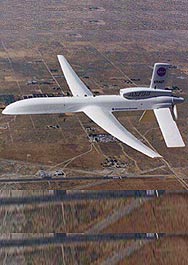 So
far, the three services have been used to handling traditional
aerial systems, such as fighters, helicopters, transport - and
in the case of the Army and the Air Force, also helicopter gunships.
The inclusion of the UAV in their arsenal now marks the entry
of a bird of an entirely different feather compared to its predecessors.
So
far, the three services have been used to handling traditional
aerial systems, such as fighters, helicopters, transport - and
in the case of the Army and the Air Force, also helicopter gunships.
The inclusion of the UAV in their arsenal now marks the entry
of a bird of an entirely different feather compared to its predecessors.
|
Copyright © 1999-2007
The Information Company Private Limited. All rights reserved
|