labels: Biotechnology, Pharmaceuticals
Scottish and Chinese centres join hands for stem cell research news
13 April 2009

Two of the world's premier stem cell research centres, Scottish Centre for Regenerative Medicine (SCRM) at the University of Edinburgh and China's National Centre for International Research in Stem Cells (NCIR) signed an agreement in Beijing to work together in collaborative research in the area of stem cell therapy.
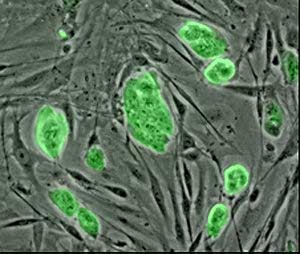
Stem CellsThe ''landmark'' deal was welcomed by Scotland's first minister Alex Salmond who is on an official visit to China.

China carries out embryonic stem cell research with its primary focus on investigating the ''molecular mechanism of embryonic stem cells and to eventually establish human embryonic germ cell lines and stem cell banks''.

SCRM is engaged in research in the area of adult stem cells which are undifferentiated found throughout the body, that divide and multiply to replenish dying cells and regenerate damaged tissues. Their recent discovery of stem cell made from skin cells to be safely transplanted into humans ultimately could bring an end to the need for human embryos as a source of stem cells.

Sir Ian Wilmut, who created Dolly the sheep, the first mammal to be cloned from an adult stem cell, signed the agreement on behalf of SCRM.

The deal alarmed the Roman Catholic church, which is strongly opposed to stem cell research using human embryos, but has no objection for using adult stem cells. A church spokesman said it is disappointing if Scottish scientists and government are involved in any way in encouraging this type of work.

However, Salmond glossed over the controversy and told the research was general in nature. ''This is about scientists in Scotland and China working together to help find cures for some of the most serious diseases of our age. It is not about a specific project,'' he said.

''It is for Edinburgh University to set out the detail but any work will be undertaken in accordance with the UK's regulatory framework and ethical standards.'' he added.

The use of embryonic stem cells had been a contentious issue drawing heated political debates in the US as well, raising objections from those who believe embryos have the same rights as living people and see its use as unethical.

Former US president Bush banned most federal funding for stem cell research in 2001 due to stiff opposition by the rigid evangelical Christian lobby.

However, president Barack Obama revoked the ban in March telling that the earlier move might have held up new cures. The president said the White House would make scientific decisions based on facts, not ideology, from now on. (See: Scientists cheer as Obama overturns stem cell ban).

Stem cell cure for deafness
Researchers of Sheffield university, UK, have announced a major breakthrough in the cure for deafness by developing sensory hair cells and brain cells that enable hearing from stem cells derived from the human inner ear. Scientists are hopeful that further work will lead to functional cells that could be implanted into the ears to treat total deafness. The research report published in the journal Stem Cells said.

Tens of millions of people across the world are deaf or hard of hearing and 90 per cent of them are due to damage to sensory hair cells and, to some extent, the brain cells that are associated with hearing.
 
Ralph Holme, director at the Royal National Institute for the deaf which funded the project said: ''Stem-cell therapy for hearing loss is still some years away but this research is incredibly promising and opens up exciting possibilities by bringing us closer to restoring hearing in the future.''

Stem cell cure for defective vision
A study at Pittsburgh university in the US revealed stem cells injected into the eyes of mice with defective corneas returned the corneas to a more normal appearance.

James Funderburgh, an associate professor of ophthalmology said Corneas can develop scar tissue from chronic inflammation caused by infections or other conditions and by injuries which can lead to a loss of visual acuity and the only effective therapy is corneal transplant.

Funderburgh said it will take about two years to develop stem cell cultures that would be suitable for testing in humans, after which they hope to begin clinical trials.

Adult stem cells for bone repairs
Researchers at Keele university in UK are investigating the possibility of injecting stem cell into the patient and manipulating them with magnets to target areas to repair damaged bones and cartilage. (See: Stem cell magic: one-shot treatment for bone injuries on anvil).

Another achievement reported at the UK national stem cell conference by Richard Oreffo, professor of the university of Southampton investigates how to fill holes or gaps in bones caused by accident or disease with a "living composite" material made of adult stem cells  The stem cells were harvested from the patients own bone marrow and mixed with biocompatible scaffold.

Results on transplants done on four patients were encouraging, as the material was integrating well with the patients own bone and stimulating growth.

Stem cell therapy for blood vessel repair
David Hess of The University of Western Ontario in London, Canada has successfully grown new blood vessels by isolating three different types of stem cells from bone marrow.

These cells, after purification were injected into the circulation of mice with one of their leg arteries and honed into the area of inadequate blood supply and induced blood vessel repair.

These principles could be applied to aid in the formation of new blood vessels anywhere in the body, like after a stroke or heart attack, Hess said.

Clinical trials on 21 patients are in progress in Houston.


 search domain-b
  go
 
Scottish and Chinese centres join hands for stem cell research