|
For the concept car zaZen, designed by Swiss design company
Rinspeed and Germany''s Bayer MaterialScience, to come down to earth will require
auto companies to figure out how to crystallise the innovative ideas, materials
and technologies into volume manufacturing. Don''t
expect to see these cars on the roads anytime soon. But the idea is fascinating
cars with transparent plastic panels, seats and dashboard displays, handles
and knobs.
On 28 February 2006, just such a car will be put on show for the
first time at the Geneva Motor Show. Only, it will be ''concept car''. It''s called
the "zaZen" (that''s exactly how it''s spelt, lower case, capital and
all). The zaZen concept has been created by Rinspeed, the Swiss design company,
and Germany''s Bayer MaterialScience, one of the biggest plastics producers in
the world. The companies hope that the new concept car will point the way to
"enlightenment for future generations of automobiles". Why "enlightenment"?
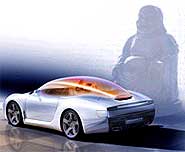
That''s possibly because one of its features is a conspicuously large third brake
light that shines out of what looks like a floating, transparent teardrop roof
(see image). The transparent rear window of the concept car turns into a "luminous
holographic area", according to Bayer. Ian Paterson,
the member of the Bayer MaterialScience board of management responsible for innovation,
believes that "The world premiere of the ''zaZen'', with its holographic
brake light and smoothly contoured single-section roof dome made of the high-tech
polycarbonate Makrolon, marks the beginning of a new era in lighting technology
in vehicle design." Rinspeed''s boss, Frank M. Rinderknecht, sees the innovative
light as a path-breaking idea. A Bayer press release is candid about the future.
It says: "In our world, it (the zaZen) will make its first appearance at
the end of February at the Geneva Motor Show. After that, who knows? We might
see some of these exclusive vehicles actually driving along our roads."
"Exclusive". That''s where the rub usually lies with most concept cars,
why they don''t roll out of mass-production factories. Concept car designers
don''t really care for the economics of car manufacturing and sales. Economic
issues are secondary to materials, design and technology issues. That doesn''t
mean that they are not useful. There is always the need to imagine, even imagine
wildly, about the future in order to make the world a better place. There is place
for aesthetics as well as technology in a future world. The
Bayer-Rinspeed concept car has named the vehicle with this in mind "to
reflect the overall attitude with which both companies have driven the entire
project forward over a period of many months. After all, Zen borrowed from
Buddhist teaching is a special form of insight that is only attainable
if you are prepared to give up preconceived ideas".
Another Swiss company
is involved with the actual production of the highly transparent zaZen. It is
Esoro, a Swiss engineering specialist. Esoro and Rinspeed have worked together
on several other concept cars in the past, including the Presto and the Splash.
Esoro made the Rinspeed Presto in 2002, and the Splash in 2004. The transparency
is there for all to see on and off. The zaZen is described as "an
automotive interplay of veiling and unveiling". Its entire roof dome right
to the belt line is made of a single sheet of transparent polycarbonate produced
by Bayer. This amazing material can be made opaque at the press of a button to
protect the car''s occupants from the gazes of curious outsiders. The Bayer
release says: "Because the transparency can simply be switched on and off,
it means that any superfluous knobs and displays on the dashboard can be simply
faded out so that the driver can concentrate on what is most important, the speed
indicator, instead of being bombarded with unnecessary information. And instead
of a living-room atmosphere, the occupants sit in ''glass-like'' plastic seat
shells in a bright and friendly orange colour. The interior is an invitation to
meditative unity for man and machine." Of course, Bayer doesn''t ask or
answer the question: if some information is "unnecessary", why waste
money to fix displays for it? But if you get too analytical, you miss out on the
fun. The fun part is what is possible. Real-world carmakers may well find
a good use for the concept in some other function. Now, if you think
that the plastic is what makes the car "exclusive", think again, although
Bayer says, "Everything has been reduced to essentials, to what really matters.
This is the heart of the ''zaZen''. The extremely organically designed body does
not assault the eye with harsh colors but exerts a quiet fascination with its
mineral-white colour." And here comes the coup. The effect that Bayer
talks about has been achieved "in an understated yet breathtakingly beautiful
manner through the use of millions of tiny precious Swarovski crystals protected
by a self-healing polyurethane clear coat". No wonder, that in its customized
suit, the concept car "seems to belong to another world". Fascinating
as the concept is, for it to come down to earth will require auto companies to
figure out how to crystallise the innovative ideas, materials and technologies
into volume manufacturing. Photos from Bayer MaterialScience (Also
see: Rinspeed
to debut its eco-friendly underwater car 'sQuba' at Geneva Motor Show)
|