labels: hdfc, interviews
The man who built HDFCnews
Deepal Trevedie
05 March 2004
He is unofficially dubbed the government's informal crisis-manager. Whether it was the UTI mess that the government wanted sorted out or a final decision on the Telecom Regulatory Authority of India, Deepak Parekh, chairman HDFC Limited, has served as an invaluable problem-solver with innovative, creative and credible alternate inputs that have shaped policy.

Though HDFC was founded in 1977, it was Parekh's vision and entrepreneurial acumen that enabled the company to create a niche in housing finance and emerge as the market leader. In a wide-ranging interview, Parekh talks to Deepal Trevedie on how the HDFC group offers a buffet of every possible financial product, besides sharing his vision for the country and HDFC. Excerpts:

How did HDFC happen?
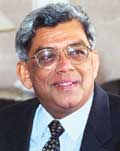
Deepak ParekhHDFC happened in 1978. I had worked in various parts of the world when HT (Parekh's maternal uncle, H T Parekh, who founded HDFC in 1977) asked me, "How long will you continue to go round the world? Come and settle down, this is an Indian organisation."
I had been to the US, the UK, Hong Kong and the Middle East, which was then every body's dream. I chucked up my multinational job and came to HDFC. And I have been here ever since.

What were you involved with before you became a part of HDFC?
I had qualified as a chartered accountant in England and had worked with Ernst & Young, Precision Fasteners, ANZ Grindlay's and Chase Manhattan in New York and Mumbai before I came to HDFC.

If HDFC had not happened, where would you be?
I would have been with a bank. Actually, I had wanted to join the Central Bank of India, but I couldn't make it.

Is there any specific reason for wanting to join the Central Bank?
I have very fond memories of the Central Bank of India. My grandfather, Thakordas Parekh, was the first employee of the bank. Even my father was a Central Bank of India employee for 40 years. He was also posted in Burma during his tenure there. I have a special affection for the Central Bank of India. Even today, I share a special bond with them. They are one of our main bankers.

HDFC has scaled several heights since the '70s. How did the transition happen?
At present, HDFC has a balance sheet of Rs 28,000 crore. From a single-product company that focused on housing finance for the middle class, we now have HDFC Bank, a life insurance joint-venture with Standard Life, a general insurance outfit with Chubb, a mutual fund again with Standard Life, a brokerage venture with Chase, a credit information bureau with Dun & Bradstreet and even a business process outsourcing venture with Tata Consultancy Services.

HDFC has reached where it is today because of sheer hard work and shared vision. We were a very small organisation and were mainly borrowers. We could not convince banks and had great difficulty in getting money. Though people would borrow from us, they were sceptical about depositing their money with us. I remember at one point of time, when I was a deputy general manager, we had to go to LIC for a Rs 10-crore loan. Today, HDFC is synonymous with housing loans in India.

Tell us about your dream of every Indian owning a house.
Deepak ParekhTo be brutally honest, we are just scratching the surface. India is extremely poor when it comes to ownership of housing property. Our housing and land policies are distorted. Urban land ceiling acts, which should have been repealed, still exist. Of course, there are places like Noida, Gurgaon and Ghaziabad, which have developed very well. But look at Mumbai.

The housing situation in Mumbai is really miserable. In fact, India is lagging behind other countries and has an unmet requirement of 20 million houses in the nation. HDFC has given only 8 lakh loans, so actually we are nowhere. Housing is the number one priority for Indians in urban areas, yet the reality is so bad. The percentage of GDP (Gross Domestic Product) that goes for mortgage is only 3.9 per cent in India. Even in a country like Malaysia, it is as high 31 per cent. Housing loans as a percentage of GDP (gross domestic product) are only 3.9 per cent in India.

What about rural housing?
Housing is not among the top priorities in rural areas, so right now it is not our focus. In rural areas, priority is on agricultural land, animal husbandry, etc.

What do you think about Goldman Sach's prediction about India? Do you feel that the BRIC (Brazil Russia India China) nations will emerge as super powers by 2032?
Why 2032? If we focus on achieving our targets, we could be there even earlier There are so many good things happening in India. Besides the technological advances happening, the pharmaceutical and automobile component industries are going to be enormous. Two international agencies have already placed India as one among the four that will be the new global super powers in the years ahead.

So, is there indeed a "feel-good" factor in India at the moment?
Definitely. With the telecom revolution, the golden quadrangle project and the overall enthusiasm among business, feel-good is everywhere.

Is Deepak Parekh a bigger brand than HDFC?
Is that so? You answer that one for me.

The 'real' Deepak Parekh
One of the lesser-known facts about Deepak Parekh is that he does not use a computer. What is Deepak Parekh, the person behind the professional mien, like? "I am very superstitious. If a black cat crosses the road, I take nine steps backwards. Also I never walk below a ladder."

Parekh also confesses to being extremely devout, "I go to Tirupati once a year. I also have strong faith in the Guruvayoor temple in Kerala and the Mahalaxmi and Babulnath temples in Mumbai. I also go to Nathdwara (a temple town in Rajasthan). But I am not dogmatic about religion."

As for omens, Parekh recounts, "At a crucial LIC meeting during our early days, I had scribbled down the names of those companies to which, we would give our first loans. From that day onwards, I have always kept that old visiting card in my wallet. It has served as a good omen for me."

Married to Smita, who teaches at the United World College at Pune, the Parekhs have two sons currently living in the US. Having spent a part of his early childhood in Burma, where his father was posted with the Central Bank of India, Parekh retains fond memories of the country. "I was fascinated by Burma. On my 25th wedding anniversary, I surprised my wife and took her to Burma. I took her to see the old house where I had lived as a kid and my old school."

Parekh's role models are an interesting mix of entrepreneurs and professionals. They include, the late Dhirubhai Ambani, Narayana Murthy and Kumar Mangalam Birla, ("for taking so much responsibility at such a young age.") However, when it comes to hero worship, the choice is clear - Keshub Mahindra - vice chairman, HDFC.

Known as a tough task master in HDFC, Parekh has the knack of retaining his best people; hardly a single person from the company's senior cadre - be it director, general manager or deputy general manager - has left the organisation in the last 11 years. Employees attribute this to Parekh's outstanding leadership qualities.

Parekh has a passion for bridge. "I am fanatical about bridge. I pursue it over week ends," he says. In addition, he enjoys Hindi music and is a cricket buff. "I don't read much except for newspapers. There is no time to read anything else." However, he finds sufficient time for charitable causes and supports 25 NGOs involved in a host of development activities, medical services and even welfare of stray cattle.


 search domain-b
  go
 
The man who built HDFC