labels: the indian merchants' chamber, interviews, profiles, governance , infrastructure - general
Bold beautification bidnews
Ranjit Hira
16 June 2003
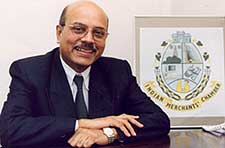
One of India's oldest trade bodies is busy salvaging Mumbai. Meet IMC president Shailesh Haribhakti, who is spearheading the dynamic initiative

Mumbai: Mumbai's infrastructure is groaning under the incessant onslaught of a burgeoning population, proliferating slums and stifling pollution. Any effort to tackle these problems must be welcomed.

The Indian Merchants' Chamber (IMC), established in 1907, is an apex body of trade, commerce and industry in the western region of India. During the course of its eventful history, it has played a pivotal role in the industrial and economic development of the country.

Its illustrious history is mirrored in the background of its new president, Shailesh Haribhakti, who is the managing partner of the Haribhakti group, one of India's oldest and widely respected groups of chartered accountants, financial and taxation consultants. His father, V B Haribhakti, was the president of the Institute of Chartered Accountants of India and also the president of IMC.

Haribhakti started working at the young age of 14 and was a topper throughout his educational career. He seems to have brought this penchant for over-achievement with him as he takes over as IMC president. He is passionate about salvaging Mumbai as a city. Here is one reason why he could succeed - Haribhakti has no grandiose plans or dramatic claims. He wants to take on just a few high-profile and doable projects under the IMC banner and ensure that they happen within his one-year tenure as president.

Domain-b interviewed him to find out more about this dynamic man who seems capable of making a success of whatever he takes on. Excerpts from the interview:

What are the new initiatives implemented by you after taking over as IMC president?
As a chamber we have played a crucial role in developing the entire country. We shall always build on this heritage, but during my tenure as IMC president I want the chamber to focus on the additional mission of trying to salvage the city of Mumbai and do whatever we can to transform it into a world-class one. We plan to do this in three ways. First, we have aligned ourselves with all other chambers and associations where we find a commonality in thinking and purpose.

Secondly, we are seeking alignment with the media - print, radio, television and the Internet. Unless we enjoy the support of the media we will not be able to extend our reach in a proper and sustained manner. For example, we believe very passionately that value-added tax (VAT) must be implemented. Even after it has become obvious that it will be scuttled due to political compulsions, we are trying to revive the concept through the media.

India is the only major country where such a tax regime has not been implemented, because taxation is state-controlled in this country. VAT will truly be beneficial to our economy. The market will automatically correct any aberrations. Unfortunately, the smaller states have elevated the giving away of tax concessions to a dramatic art form. The reality is that investment is attracted by good infrastructure; attractive environment; effective, pro-business laws, consistently sound justice and a fair and reasonable tax structure. We will not give up our effort to enforce VAT.

Thirdly, we are actively seeking help from business, industry, politicians and bureaucrats. We are trying to align ourselves with the basic political process and reach out to all politicians and bureaucrats. We will try to create and drive economically sound policies. We hope to do this by first creating a neutral platform, where we can bring together all political parties on issues that all of them would unhesitatingly support.

One such burning issue is the badly-stalled development of Mumbai. No political entity should object to the sincere efforts to improve the city in even the smallest way. The issues are too numerous to be tackled at one stroke or by one organisation. Poverty and decay are increasingly visible; roads are more and more unclean and badly maintained; pollution is increasing at an alarming pace; no new industries are being set up - in fact, existing industries are struggling to get out of the city.

Of course, the exit of polluting industries is a good thing. But the earlier vibrancy of a rapidly growing city is gone. That dynamics must be recreated. I don't think any political party can take a contrary view on this. In fact, we have already been able to get every political party on to the chamber's platform and commit itself positively to these issues.

Our next step is to take the media's help and publicise these issues. Every word spoken at our meetings is documented. We then convert these discussions into publications. These publications are sponsored by industry, through advertising support, and mailed out to 3,000 to 4,000 key decision-makers. The total readership of each publication exceeds 15,000.

But are you also seeking a mandate from the government to act as a nodal agency on these issues? Without a mandate your efforts will remain just academic.
Yes, that is a step we took simultaneously. We requested Maharashtra's finance minister to ask us to form a small subgroup, from among the chamber's office-bearers. We then requested the issuance of a government regulation (GR). Unfortunately, before this could be done, the state government changed, almost overnight. We are again trying to get a GR issued.

I am also trying to get the chamber's members to participate actively and take on the 'ownership' of specific issues under our overall vision. This should help in getting things done in a better way and also ensure continuity of effort, even if it takes longer than one year. I have also empowered the chamber's secretariat to take concrete actions to further the realisation of our vision.

Another major, allied effort is research. Our library is already outstanding. We are in the process of converting it into a digital repository. We will become as Web-savvy as possible. We will also start publishing research-based reports - we have planned 12 this year, of which two are already out. One is on issues concerned the development of Mumbai. The other is on public governance. The third one will be a comparative analysis of the reforms process in India and China.

We have requested [HDFC chairman] Deepak Parekh to lend his might and support for the purpose of setting up an economic research foundation. The initial corpus has already been mobilised. We have already received Rs 50 lakh, which we are trying to raise to Rs 1 crore. The entire treasury of IMC will be about Rs 12 crore. We are becoming financially stronger year by year.

How does this compare with CII [Confederation of Indian Industry]?
CII has a Rs 100-crore corpus. No other chamber comes anywhere near that, but our strategy is to align ourselves with all other organisations, including CII, as long as they also believe in what we are trying to do. We have already received a Rs 50-lakh grant from the Ford Foundation to do a two-year study on business-police initiatives in Mumbai with the objective of improving policing in Mumbai. Several leading ex-police and ex-CBI officers have agreed to work with us on this project. We are against strikes or bandhs in any form. We are always for mediation. We already have a full-fledged, about-to-become global and arbitration service. Ours is the most active conciliation and arbitration chamber in India.

Is it true that the credit should go to IMC for breaking the recent nationwide transport strike that crippled the country?
Absolutely. We were able to make them see that they would never be able to get away without complying with pollution regulations. Once they accepted that, all that remained was to communicate with the political and bureaucratic establishment. We then 'hand-held' the entire process up till the final settlement.

Do you think you will be able to persuade the government to follow a 'hands-off' policy while you actually implement your specific projects to 'save' Mumbai?
We will focus only on three or four very visible projects. One project we will implement is the cleaning up of the Bandra-Kurla complex. We will work with the Mumbai Metropolitan Regional Development Authority. ICICI Bank is willing to bankroll the entire project. We will request the government to simply let us do it.

The second project we want to implement is to create a 'happy experience' along the route from the international airport to the highway. We want to create a green and beautiful welcome to Mumbai. The third project is the cleaning up of Dadabhai Naoroji Road, from CST to Regal Cinema. This is a key part of Mumbai's heritage precinct.

Another important project that has been languishing for many years is the cleaning up and beautification of the eastern seaboard, where the dockyards are located. Today, we have a horrible looking P D'Mello Road, which runs parallel to the dockyards. It has been polluted beyond recognition. Mumbai's port area was originally quite lovely. Look at Navi Mumbai today - it is well planned and well maintained.

That's true, but if it was planned to decongest the city then why does it still take more than one hour to reach Navi Mumbai by train? A fast train could easily reach within 20 minutes but the extra tracks needed were never built.
We will look into this. We must improve our infrastructure to world standards. Mumbai can boom if it encourages the service sector. We can become the business process outsourcing (BPO) capital of the world. One piece of good news is that the Diamond Bourse at Bandra-Kurla complex, which was a terrible eyesore, is finally being restored. It will be ready for occupation within a year. We have no hesitation in letting anyone take the credit for specific projects.

I just want Mumbai to become one of the world's most beautiful cities. It makes me very angry when I see people spitting or throwing cigarettes or garbage on the roads. All it needs is better discipline. Any person who pollutes should be punished swiftly and adequately so that he never does it again. The laws are in place but they are not being enforced. Thousands of other cities around the world are clean and spotless - why can't we do the same?

Everyone agrees that Mumbai should have a world-class airport. Everyone wants Mumbai to become a financial and BPO powerhouse. We must make it happen. We are the ones who are holding ourselves back. These basic concepts need to percolate into the minds of our citizens right from the school level onwards. Another issue that makes me very upset is the black smoke from vehicle exhausts.

But that has diminished a lot since the Supreme Court forced all the taxis to switch to CNG.
It has diminished, but it's still very bad by international standards.

Why don't you think in terms of an even bolder initiative, such as replacing the entire fleet of taxis in Mumbai at one stroke, by arranging for the funding in the form of an interest-free loan or a grant?
That is a good idea. I think it can be done. We must make the effort. I think the funds can be mobilised if we articulate the idea in the right circles. Whenever this is done it creates ripples and whoever really wants to contribute in any way comes forward. It then builds into an actionable issue.
Talking about bold initiatives, we are keen to take on corruption. We have arranged for top cops like D Sivanandan and Julio Ribeiro to sit in the chamber's office at a fixed time. Let people come forward and complain, without any fear, about public officials who are demanding bribes.

Will you arrange in advance for reliable sponsors for each of the projects you have described and complete them in a professional and time-bound manner?
Certainly. One of the projects that I am personally very keen on is the Skybus mass transport system, developed indigenously by the Konkan Railway Corporation. It deserves to be tried out. It can diminish congestion very efficiently and cost-effectively. I am trying to overcome the problems connected with the fact that it has never been implemented before. We must set up at least a 5-km track to validate the technology. If it succeeds we can not only use it all over India but also export the technology around the world.

What is your view of the idea that the only method that seems to work in India on major issues is PILs [public interest litigations]?
We have considered this point - as to whether we should support PILs that are aligned with our own views. I think we will have to be very selective. For example, there is the issue of excessive public holidays, which have crossed 100 in a year. I think it will be worthwhile for us to support a PIL on an issue like that. The other way, of course, is to build a consensus in favour of issues visualised by IMC. I want the chamber to build a reputation for getting things done. We are in the process of creating a 'voluntary code,' which all our members should sign. I want to create a 'pull' effect, which motivates people to come to us and support us vigorously in getting things done.

If you succeed in doing this it will create a landmark precedent, which will be replicated throughout the country.
I sincerely hope so.

Do you plan to announce weekly or monthly targets related to the projects undertaken by you?
Yes, we will do so. It will make us truly result-oriented and keep us focused on doable and specific projects, which we can monitor at the micro-level and thereby build our reputation step by step for really getting things done. This is very consistent with my own personal way of thinking - creating a 'pull' effect. If anyone is interested in Mumbai's development, well, come to us, help us, support us. What is your personal opinion about the overall strategy that I have articulated for the chamber?

I think the main projects must be implemented and completed in a sure-shot, time-bound manner, or they should not be taken up at all.
I agree. But some critically important issues can take a long time to resolve. We are therefore keeping everyone in the chamber's committee informed about every aspect of all our initiatives as well as our progress, so that we can ensure the continuity and vigour of our efforts over the next five years.

We are planning for a smooth, five-year leadership transition, which will not deviate from our articulated objectives. We will also set up a tracking system to minutely monitor progress on each issue. On a very selective basis, if we cannot complete any particular project due to insurmountable obstacles we will swiftly shelve it and move on to another, more doable project. We will, of course, put in our utmost efforts to see that each project we undertake is carefully vetted before we start and is completed successfully and on time.


 search domain-b
  go
 
Bold beautification bid