|
Mumbai:
Each time I interview an architect or an interior
designer, his or her background and the career path s/he
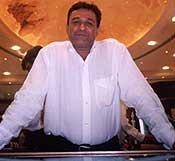
has taken intrigue me. Dushyant Ghatalia, a Mumbai-based
architect and interior designer is no exception. Hes
a consultant and an entrepreneur.
After
graduation, Ghatalia left for Canada where he apprenticed
under reputed architects. During this time, he worked
on varied reputed projects like Mount Sinai hospital;
departmental stores, like Marks and Spencers at Montreal,
Canada; public facilities like North York Civic Stadium
and various other residential and office buildings.
Ghatalia
returned to India in 1984 to set up an independent practice,
Ghatalia Associates, with his wife Darshana Ghatalia,
in the western suburbs of Mumbai. The architecture and
interior designing industry has seen tremendous growth.
In an interview Ghatalia talks about the industry and
how it relates with the present Indian economy.
What
kind of work does Ghatalia Associates do? What are some
of its success stories?
Our company does any kind of work that stimulates, to
create something new, something that has not been done
before. We are passionate about doing something different,
whether they are retail outlets, offices or residences.
After understanding what our clients require and the budget
assigned for the project, we try to do what suits them
best. We avoid taking on anything that is not very clear,
and we maintain a lot of transparency in what we do.
Some of the prestigious projects that Ghatalia Associates
has worked on include corporate houses like American Express
Bank, Dow Jones Telerate, Oppenheimer & Co, Sony Entertainment
office, Asian Capital Partners, Kleinworth Benson Strategic
Capitals, entire projects that included residences and
offices of RNA Builders and Manickchand Group, homes and
showrooms.
How
do you measure and validate your results?
We try to retain our clients. I guess word of mouth has
really moved us on. Near-to-perfect coordination between
clients, contractors and architects is maintained. We
call this project management, and if the link
loosens, we fail. This is coupled with cost, concepts
and time management.
Is
Ghatalia Associates all about customer experience? Or
is there something else as well? How do you measure improvements
in customer satisfaction?
Yes. Ghatalia Associates is about customer experience.
Every experience is different, even if we were to follow
it by the management techniques we have outlined at the
company, although at times the client and contractor may
not want to follow it. Turning towards the project, though
results are never 100 per cent, success stories have been
anywhere between 85-99 per cent. The reasons for the shortfall
are mostly external factors like holidays, riots,
lack of coordination when client is not available, money
shortage
What
is the most important factor that contributes to the success
of your company?
Getting involved with every project. I prefer to involve
myself right from the design stage to space planning and
detailing, even in sessions with the contractors and suppliers.
You
use a lot of computer graphics in the company. How did
you originally become involved with computer graphics?
How many people work at it?
Yes. Back in 1982, when in Canada, I still remember doing
everything manually. At the time, there was no software
available for architects. Ghatalia Associates got the
first computer in 1988. We adapted to the changing times.
Today the studio uses a lot of 3D Max, Auto CAD, vision,
ad lightscape. The studio has five people working
all architects, one of whom is a graphic designer, too.
You
have done some rather impressive work. Is there any single
project that you are proud of?
Not really. Each project is treated with same enthusiasm,
though they may be different. Today, the company is abuzz
with a new project in Mauritius, which every department
is working on to hit schedules.
I
understand that this Mauritian project is a rather impressive
one and you have tried to make changes to bring the project
around, and even advice the Port Trust authorities. Could
you tell us a little more from start to finish?
We are offering the client a total design solution here.
This 70-acre hotel project at Port Lois began six months
ago. A Mumbai-based client brought the proposal to us.
At the designing stage, when we had meetings with the
Mauritian Port Trust Authority (MPA), one thing led to
another. We realised that there was a need to develop
the property around that and since Mauritius does not
have a business hotel, it was ideal that we propose the
same. A complete presentation has been made and we now
await their consideration and hope for the best.
How
big is the architecture industry in India today? What
is your contribution?
Huge
with room for every genuine architect. My contribution
is to my firm. Our clients have been happy with us so
far. I really do not bother how others work.
How
would you define an architect, today?
Most of them in India are businessmen. They cut jobs,
take kickbacks and balance their own accounts. The main
problem usually lies with the clients they look
for bottom fishing (cheaper job alternatives). What they
do not realise is that they pave the way for such professionals
to agree with them. More than ever, the clients
returns on investment are compromised pay less
and get the maximum out of their deal.
Clients
are in for a rude surprise. It would prove better in the
long run if clients would stick to the norms of the Architects
Association, rather than opt for a cheaper compromise.
The architect, on the other hand, should work honestly,
regardless of how expensive or cheap the project is. Professional
practice does not permit cutting down on the fee structure
and taking interest from elsewhere.
What
do you think are the problems that the architecture industry
faces today?
Firstly, this is a profession and not an industry. Like
I said earlier there is enough work for all especially
the ones that do it well. Today there are architects with
not much experience, in terms of design capabilities,
but they do enjoy excellent PR. These kind of people get
their business going through networking. Some, I must
say, are really good. The circuit is self-appreciative
and the client pays a rather large price if he is not
careful about who he is dealing with.
As
someone with a real architecture background,
what do you think of todays mushrooming architect-interior
designer profession? Are you concerned that some of them
are perverting the true meaning of the term?
Most of those who have worked in various related areas,
for say 10 years, would have gathered enough experience.
Nearly every person, after education, apprentices under
an experienced architect. While there may be many entering
the profession in the urban areas, there are very few
in the rural areas.
People
from rural areas move to urban areas for apprenticeship
and job opportunities. There is an issue here; while there
are no yardsticks for professionalism here, they offer
cheaper solutions to get jobs and compromise on materials
used, time, work etc. They too need to survive. Sad to
say, but we allow such things to happen. Look around.
Why do some of our government buildings look ugly? Why
is our airport nowhere near to international design? Even
the Housing Board building is ugly. Why are all these
happening? Ill tell you. Cheap architecture is bought
as a result of which these buildings are non-functional
and non-maintainable.
There
are some excellent architects in Ahmedabad, Bangalore,
Delhi and Mumbai. The growth in the industry is fast and
big so much so that the architects working on a project,
say in Bangalore, would be from Mumbai.
In
your opinion, how would you rate institutions like IIID
[Indian Institute of Interior Designers] and PEATA [Practising
Engineers and Architects Association)? Are you a member
in any of these?
No. I am a member of the Council of Architects. This is
a controlling body of architects.
|