labels: Management - general, Telstra
David Thodey to replace Sol Trujillo as Telstra CEO news
08 May 2009

The prolonged Telstra-Rudd government stand off seems to have finally ended with the telco deciding it was time to improve relations with the administration. The company announced that David Thodey, head of its government and enterprise unit would take over the reins as chief executive.

Telstra, formerly owned by the Australian government, is the largest provider of both local and long distance telephone services, mobile services, dialup, wireless, DSL and cable internet access in Australia.
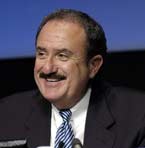
Sol TrujilloUnder former chief executive Solomom (Sol) Trujillo, the telco has hardly been on the best of terms with the government and had its bid for a $15-billion telecom project rejected by the government for failing to comply with bid requirements. The telco had for months earlier threatened to pull out of the tendering process unless the government removed the condition for a structural separation of its broadband network infrastructure from the retail arm.

Thodey, 54, is widely believed to be the government's preferred candidate for the post. The appointment of Thodey brings brings down the curtain on a stormy period marked by confrontation in Telstra's relationship with two governments since the appointment of Trujillo in 2005.

Telstra chairman, Donald McGauchie has been making conciliatory moves in recent months which seem to have gone down better with the government. It has welcomed this as a sign of a more constructive approach.

But the government may be expected to negotiate hard over the building of its proposed $43 billion national broadband network, which will severely test Thodey and the board.

Thodey's appointment by the telco's board comes after a two-day meeting which concluded late yesterday. Thodey, an Australian is not known for having a close relationhip with key government ministers, but is regarded as relatively calm. He is also not associated with Trujillo's aggressive strategy against government regulation over the past few years, which according to analysts would be an advantage.

Thodey has his work cut out for him. He will first need to convince investors that he will not make too many concessions to the government that would harm the interests of shareholders. The costs of building the network and what it will charge to consumer would be determined by the returns Telstra expects and intense and lengthy negotiations can be expected.

Many investors are angry with the board and some big investors like the Future Fund's David Murray and some institutions have suggest that McGauchie should depart as well.

Institiutional investors however insist that it was not the right time to appoint a new chairman and that McGauchie was more than capable of leading Telstra closer to the government without compromising shareholder interests.

An important issue for the telco concerns government's threats about forcing the company to sell off its valuable assets if it did not get co-operation. However, meeting the threats would likely require Telstra agree to a structural separation of its retail and wholesale arms something it had stiffly resisted until the past week.

Trujillo's tenure will end on 30 June and his replacement is expected to help the company, as it enters into a more cordial relationship with the government. According to analysts, the company's stock which closed 1c lower at $3.24 yesterday is set to rise.

Trujillo, who joined the company as CEO on 1 July 2005, is among the few business leaders to have served as a major-company CEO on three continents: at 32, became the youngest officer in the history of AT&T. From 1992-95 Trujillo was president and CEO of US West Dex Inc and from 1995-1998 he was president and CEO of US West Communications and from 1999-2000  CEO and chairman of US West Inc.

Within months of taking charge as Telstra's CEO, Trujillo unveiled a five-year strategy to transform Telstra into an integrated, fully converged media-comms company centred on the customer in November 2005. The transformation  milestones under Trujillo include include launching the nationwide wireless broadband under the brand Next G network in October 2006, the Next IP network in April 2007 and the restructuring of the business based upon what the company calls 'market-based management'.

After the Australian government divested its remaining 51-per cent stake in Telstra, Trujillo embarked on Telstra's transformation. Telstra has acquired majority holdings in three Chinese internet companies including SouFun, the number one real estate portal, and merged Telstra's CSL business with New World PCS to create the leading mobile operator in Hong Kong.

By 2008, Telstra's transformation had produced world-leading performance among incumbent telco peers in many key metrics including domestic revenue growth, slowing fixed line losses, 3G mobile subscriber penetration and growth in both broadband market share and average revenue per user.

As a manager, Trujillo demonstrated his commitment to increasing the breadth and depth of management experience by raising the levels of ethnic, gender and industry diversity. At Telstra he quadrupled the number of women Group Managing Directors.

In 2008 Trujillo was invited to be a member of the World Economic Forum's steering committee on climate change, following Telstra's 2007 report, Towards a High-Bandwidth Low-Carbon Future – Telecommunications-based Opportunities to Reduce Greenhouse Gas Emissions. He was also was elected a member of the GSMA board in 2008 reflecting Telstra's leadership and innovation in wireless broadband development through its nationwide Next G 3GSM network.

Trujillo was the first native born Hispanic-American to serve as CEO of a Fortune 150 company and has held board memberships in a number of global companies including: PepsiCo, Target, EDS, Gannett, and the Bank of America. Trujillo was also a member of the chairman's advisory council of Alcatel between 2000 and 2003.


 search domain-b
  go
 
David Thodey to replace Sol Trujillo as Telstra CEO