labels: Samsung India
Samsung chairman's resignation may mark the beginning of the end for chaebols news
24 April 2008

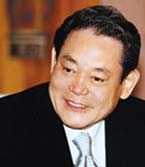
Kun-Hee LeeThe chairman of South Korea's South Korea's biggest conglomerate, Samsung, Kun-Hee Lee, one of South Korea's richest men, has resigned within a week of being charged with  evading $113 million in taxes and breach of trust.

The electronics and semiconductors maker is one of South korea's most powerful and respected organisations with annual profits of over $12.9 billion.

The charge against Lee follows a three-month investigation into allegations of corruption and using illegal accounting techniques to transfer control of the business to his son.

Though the investigations cleared the firm of a former executive's allegations that Samsung had used  a multi-million dollar slush fund to bribe prosecutors and judges, prosecutors had indicted him with tax evasion last Thursday.

However, prosecutors did not formally arrest the 66-year-old Lee, saying he would remain free pending his trial.

Earlier during the investigations, Lee had denied any wrongdoing, while saying that he assumed responsibility and would even consider stepping down.

Group vice chairman Lee Hak Soo and president Kim In Joo will quit by the end of June, Samsung said in the statement yesterday that brought news of Lee's departure.

The group's strategic planning office, which controls group operations, will be dismantled and Samsung may turn into a holding company, the statement said.

The resignations creates a vacuum atop a business empire that was started in 1938 by Lee Byung Chull, Kun-Hee Lee's father. The current chairman's departure will leave Samsung affiliates under independent management, according to the company.

Analysts say the of Lee may mark the end of the days of influence of the chaebol (alternatively Jaebol, Jaebeol) thayt refers to a South Korean form of business conglomerate. The Korean word means "business group" or "trust" and is often used the way "big business" is used in English. Chaebols have dominated the Korean business landscape for decades.

Through its 59 operations, Samsung's influence stretched into nearly every aspect of Korean industry, from property and mobile phones to flat screen televisions and hospitals.

The group accounts for as much as a fifth of South Korea's exports, 18 per cent of its gross domestic product and 20 per cent of the market capitalisation of the Seoul exchange's benchmark Kospi Index. Such is its importance that national television interrupted regular programming to carry Lee's resignation speech live.

However, Samsung's influence extends not only to many corporate sectors, but also in how business is done in the country. It is in this respect that analysts feel the recent fiasco will be most damning to the existing business structures.

In addition to the charges of tax evasion, Hee faced charges of breach of duty for trying to cede future corporate control to his son Jae Young Lee. With Hee's resignation and the transfer of his son to remote overseas operations, the underlying concept of a chaebol, handing over reins to a successor from the family, has been effectively undermined. For the first time in 40 years Samsung is under the control of professionals, not scions.

The tax evasion and breach of duty charges resulted from a probe that began in January after Samsung's former chief lawyer, Kim Yong Chul, issued public allegations of financial irregularities. Other Samsung executives were charged with similar offenses, including group vice chairman Lee Hak Soo and president Kim In Joo.

Prosecutors said that the strategic planning office was involved in managing about 4.5 trillion won ($4.5 billion) in funds and helping the transfer of control to Hee's son Jae Young Lee. Prosecutors said they found no evidence of Kim Yong Chul's central allegation - that the group diverted funds to bribe government officials and journalists. Kim had alleged that the planning office directed the purported bribery operations.

The family-controlled chaebol emerged in Korea after Park Chung Hee, who seized the country's presidency through a military coup in 1961, promoted industrialisation through multi year economic plans. The International Monetary Fund cited the chaebol's debt-driven practices as part of the reason the economy landed in a financial crisis at the end of 1997.

Lee's family controls group units through a maze of cross shareholdings. For example, the chairman and related parties own 36 per cent of Samsung Life, which in turn is the biggest shareholder of Samsung Electronics, according to regulatory filings. The chairman's son is the second-largest owner of Samsung Everland Inc., the group's de facto holding company.

Critics of the chaebol system say that these cross holdings enabled an owner with relatively few shares to wield unlimited power over the conglomerate. They contend that severing these cross holdings and switching to a holding-company structure, which has been proposed for Samsung, would help direct a company's cash to itself and to shareholders, make operations more transparent and the management more accountable.


 search domain-b
  go
 
Samsung chairman's resignation may mark the beginning of the end for chaebols