labels: air conditioners & refrigeration, marketing - general
Cool machines face the heatnews
Mohini Bhatnagar
02 July 2004

Exchange offers, new innovative product introductions, cutthroat pricing, easy financing et al, the refrigerator makers in the country are using just about every trick in the book to push their products.

Some of the strategies employed by leading white good makers in the country to push their cool machines are worth taking a look at.

Godrej has recently launched the Pentacool range of refrigerators with Pentafresh technology. The technology has an electronic cooling system that allows one to set the temperature inside the refrigerator more precisely than an electro-mechanical cooling system. Godrej has also launched a stainless steel finish in its direct cool and frost-free range. Godrej currently sells 170-litre direct-cool refrigerators for Rs5,800.

Godrej has also introduced the 'Fresh Zindagi exchange offer' for its range of refrigerators under which consumers can get upto Rs10,000 off on the MRP of a new Godrej refrigerator.

Whirlpool (India) has been constantly innovating and highlighting new USPs for its refrigerators. Starting with the 'Fast Forward ice' innovation, the company has lately brought in what it claims is the world's first single-door frost-control refrigerator with which it plans to enter the mass segment. Conventionally, direct cool fridges are single door while frost-free refrigerators have double doors.

In India, direct cool refrigerators are estimated to account for 85 per cent of the total fridge market.

According to Arvind Mendiratta, the CEO of Whirlpool (India), the company aims to cater to both the direct cool and frost-free segments. He says that though frost-free technology is superior, in India most people prefer direct cool due to frequent power shortages and eating habits. Hence the new range has been developed combining the benefits of frost-free and direct cool.

Whirlpool also introduced the 'six sense' proprietary technology, which automatically maintains the requisite temperature inside the fridge. The sixth-sense frost-control refrigerators provide the benefit of total freedom from defrosting and cleaning water puddles besides being high capacity refrigerators with additional space. The new range is available in 200 litres, 230 litres and 260 litres at an approximate price range of Rs10,600 to Rs12,750.

Whirlpool fridges, he disclosed, are priced at an approximately three per cent premium mainly because of their superior technology."But we do not want to be a niche player. We want to be in the market where volume is," adds Mendiratta.

Whirlpool has earmarked five per cent of its revenue on ad spend and is aiming at a 15 per cent rise in sales turnover this fiscal over Rs1,300 crore last year, mainly helped by the increasing sales of refrigerators. The new single-door frost-control fridges are expected to contribute 20 per cent of overall fridge sales.

Electrolux Kelvinator Limited (EKL), the Indian subsidiary of AB Electrolux, the world's largest powered appliances company, has come in with an innovative battery-powered refrigerator. The first refrigerator in the world to work without electricity, the 170-litre 'Bijli' is priced at Rs10,990, and is equipped to offer 12-hour power back up with a built-in power pack, which will operate on an external connected battery. EKL is planning to launch an extensive Rs4-5 crore multi-media campaign around the battery-powered 'Bijli'.

Rajiv Karwal, managing director and CEO, Electrolux, feels the market for refrigerators is huge and largely untapped. He is confident that this battery-powered fridge will create a huge demand for fridges with power back-ups. Clearly the USP of the product is electricity or the lack of it.

Bijli's tagline says it all, 'Power gone phir bhi fridge on'. Along with Bijli, EKL has also launched a refrigerator named 'Tamanna', equipped with an FM Radio and a message recorder. Its 10-second TV commercials, already on air, target Indian women in the 20-35 year age bracket. Tamanna is priced at Rs13,990 in north India and is available in a 230-litre capacity only.

LG Electronics India and Samsung Electronics, the Korean chaebol, are the leaders in the frost-free segment in the market and are growing the fastest in the category. Both are focused on frost-free refrigerators and have positioned their products on preserving the freshness of the food - the health benefit.

This year LG has launched products catering to both ends of the spectrum. While on the one hand it launched an extremely hi-end product aimed at strengthening its digital product portfolio - the TV refrigerator called TV Dios - and on the other hand it is bringing in a Rs5,000 fridge to cater to the rural markets.

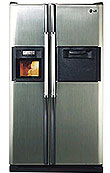
TV Dios, "that brings together the best in food preservation and storage with multi-media functions as a quintessential digital home appliance," comes with a 13-inch hi-definition TFT LCD TV installed in the centre of its door. The 600-litre TV Dios, priced at Rs2 lakh, also has a built-in radio tuner providing access to FM stations and is supported by built-in speakers.

LG's Rs5,000, 150-160 litre direct-cool refrigerators to be launched by July this year are targeted at the rural population who cannot afford premium products, says Ajay Bajaj, product group head, refrigerators at LG.

Samsung plans to stay away from rural markets. Its direct-cool refrigerators start at Rs 7,900 for a 170-litre fridge, and the company's strategy is to provide maximum value addition in both volume and premium products.

LG, which currently manufactures up to 310-litre refrigerators in India, plans to launch 400-litre models, to be rolled out from its new manufacturing facility in Pune. The company imports the above 350-litre category of refrigerators from its parent company in Korea.

The Indian refrigerator market is very small and accounts for sales of around 3.5 million units per year. The intense competition among the major players has led to most players realising small
margins. Despite a reduction in the customs and excise duty, from about 14 per cent in 1998 to 8 per cent in 2003, levied on the refrigerators segment most companies are still making losses.

According to trade journals, Whirlpool India, the Rs1,558-crore home appliances company, is the leader in the domestic refrigerator industry, with a 26-per cent share. A majority of the company's revenues, about 65 per cent, come from refrigerators. Last year the company declared a net loss of Rs34 crore.

Whirlpool is now contemplating a significant shift in its focus areas and is eyeing the huge air-conditioner and microwave market in the country for its future growth and comfortable margins. Whirlpool officials said enhanced competition and significant price erosion due to a steep rise in input prices of commodities, in the refrigeration segment, have put the company's margins under severe pressure.

The company has been taking stringent cost control measures, new trade management strategies and increasing efforts to implement lean management programmes and eliminate wastage in all areas of manufacturing. The company has also converted its Pondicherry facility into an export-oriented unit. The air-conditioner category, with an industry size of Rs1,500 crore, presents a big opportunity. The microwave business, given the extremely low penetration levels, has a large potential in terms of growth officials say.

Godrej Appliances is the second largest player in the market with a 20-per cent share. The company sold 7,500 units of frost-free and direct cool refrigerators in 2003-04. It has been making operating losses and its market share in the segment has been falling. Godrej has been eyeing the South-East Asian and African markets for exports.

Electrolux Kelvinator reported net losses of Rs170.3 crore during 2003. The company has been restructuring its operations and wants to stay positioned as a premium player. The company feels it has established the Electrolux brand with a cost competitive product line-up and intends integrating its Indian operations with its global network.

Electrolux is expanding its existing Shahjahanpur R&D centre in Rajasthan. The research centre will attract Rs 40 crore in investment over the next three years, and the manpower strength is being doubled to 40. The company is projecting to source $300-million worth of components from Indian vendors over the next three years and shifting a part of its North American call centre operations to India.

Electrolux feels that in the Indian context, power availability is a major issue and intends to launch appliances in tune with these concerns. Keeping in mind the price sensitive nature of the Indian market the company will focus on product features.

A recent FICCI report has provided a silver lining of sorts to the dismal industry scenario by pegging the growth of consumer durable goods in the rural markets at around 25 per cent as against 7-10 per cent in urban areas in the last financial year.

The report shows buoyant trends in the consumer durable goods sector led by colour TVs and refrigerators, followed by ACs, microwaves and other electronic gadgets.

Companies like LG have already been reaping the fruits of its rural focus. According to the company, 55 per cent of its Rs4,500-crore turnover last year was contributed by the rural and semi-urban markets.

LG is now targeting a 65-per cent contribution from these regions in the current financial year. Voltas, another white goods major is also eyeing the rural markets.

Refrigerators and CTVs are heavily in demand in the rural areas where the main concern are electricity rather than affordability. That's where Electrolux's Bijli seems to be a likely winner.


 search domain-b
  go
Legal Policy | Copyright © 1999-2007 The Information Company Private Limited. All rights reserved.  
Cool machines face the heat