Indo-US nuclear deal: A time for gratitude
26 September 2008
Washington: Amongst all the twists and turns that it has presented to an enthralled audience, the Indo-US nuclear deal also threw up a poignant moment when the Indian prime minister Dr Manmohan Singh used the occasion of a post-meeting media briefing to express his gratitude for US president George W Bush. "And when history is written, I think it will be recorded that president George W Bush played a historic role in bringing the two democracies closer to each other," said Dr Singh.
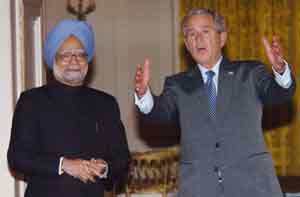 In a story that has been notable for hard-nosed deals, meetings and high-decibel showdowns, this very personal touch from the Indian prime minister, in full media glare, has come as a surprise, even for the hard-nosed. Dr Singh thoughsoft-spoken is also amongst the most reticent of world leaders and so his public acknowledgment is all the more extraordinary.
Earlier, the Indian prime minister flew in from New York today for a meeting with president Bush on Thursday even as some uncertainty prevailed whether the US Congress would be able to push the legislation, ratifying the Indo-US nuclear deal, through by Saturday. This is the last scheduled day for this Congressional session.
Dr Singh went in for a meeting that began 20-minutes late even as president Bush played host to US presidential candidates John McCain and Barack Obama. The meeting with these candidates was an attempt to reconcile differences over the massive bailout plan moved by president Bush before the US Congress to rescue stricken financial institutions.
According to officials, the two leaders discussed the status of the deal and a range of issues covering Indo-US strategic partnership.
Speaking to reporters at the Oval Office, after a 40-minute meeting with Singh, Bush said he was working hard to push through the Indo-US nuclear deal as quickly as possible. It had taken a lot of work from both the countries, he said. "We want the (123) Agreement to satisfy you and get it out of our Congress. And so we're working hard to get it passed as quickly as possible," Bush said.
