labels: healthcare, infotech, hardware - infotech
For a back-to-back viewnews
03 September 2005

Chennai-based cardiac surgeon Dr D Janardhana Reddy and L Narayanan, MD, Silicon Labs, talk to V Jagannathan on their innovative double-sided monitors for PCs and laptops, that will soon be on shop shelves.
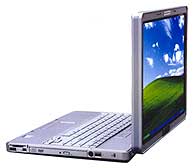
Chennai: The software engineer sitting before Dr D Janardhana Reddy, head of the cardio-thoracic surgical unit was speechless. Sitting opposite the cardiac surgeon, he was watching Dr Reddy''s laptop with astonishment.

Not because the doctor had made a startling disclosure about his father''s health. Nor was it because the surgeon showed him something unusaual on his laptop. But it was the way the laptop that was so unusual.

The laptop, an unbranded product, had a back-to-back dual screen. "He couldn''t believe what he was seeing, more so since he was an IT professional. He seemed dazed at the product and didn''t pay attention to me for nearly ten minutes," recalls Dr Reddy. The doctor then explained to the software professional that the dual-screen laptop was his own patented invention that was pending being be commercialised.

The Chennai surgeon explains what sparked the idea for a dual-display computer, "One evening a sales representative, who called on me was trying to show me his company''s products on his laptop. Whenever he turned the laptop around for the screen to face me he, was unable to see and convey what he was trying to explain and, whenever, he turned the laptop towards himself, I could see only the rear of the screen."

Driving home an idea struck him: why not have a dual-screen … a back-to-back screen laptop. As a surgeon he began visualising how that would ease his job of explaining a heart-valve block to patients and their families. "They wouldn''t have to cluster around my table to look at my laptop. I also imagined how my grandchildren could be taught their alphabets with the dual-screen computer," he adds.

Innovating comes easily to this cardiac surgeon who is held in high regards in the field of reconstructing damaged hearts caused by heart attacks. He has developed and patented a couple of innovative products that are being used in cardio-thoracic surgical procedures.

On reaching home, Dr Reddy called his friend L Narayanan, managing director, Silicon Labs Pvt Ltd, to find out the possibility and feasibility of developing such a product. The Rs2-crore turnover Silicon Labs manufactures medical devices like electrocardiographs (ECG), pulse oxymetry, defibrillator, pacemaker, central monitoring stations for intensive care units, nerve locators and monitors for operation theatres, etc.

Narayanan, a masters'' degree-holder in engineering instrumentation from the Madras Institute of Technology, too, was keenly attracted to the idea. It was nothing but natural as his company has several firsts to its credit in India. Silicon Labs is the first Indian company to design and manufacture pulse oxymetry, ECG monitors and similar products. The company was also the first to come out with a health station — a set of small gadgets that would measure a person''s blood pressure, height, weight, pulse rate, blood glucose and cholesterol levels.

Says Narayanan, "I immediately realised that his idea was feasible." The next day Narayanan dismantled one of the laptops in his office to understand the circuits and the signals that run the equipment. This happened six months ago.

And on August 31, 2005, the duo officially unveiled two prototype of back-to-back dual screen thin film transistor (TFT) technology laptop and desk top monitor, with multi functional utilities to the world. Before that they had secured an international patent for their innovation.

Says Narayanan, "The laptop / monitor allows users seated on either side of a table to simultaneously view, communicate and digitally interact with content." The monitor also enables simultaneous internet browsing.

Actually the use to which the dual screen monitor could be put to is actually limited only by imagination. With the help of software one can even partially mask the content and display information selectively on any one side (useful in commercial applications) and also provide interactive tools and features on any one side. "It also helps in parent child-computer interaction, and trainer-trainee or student-teacher interactive learning, corporate and professional presentations and discussions, presentation of dynamic interactive content in sales and marketing, retail billing and many others.

Gaming is another huge area where these monitors have an application. The monitors have the facility of switching off of any one side for single use.

Recalling how the product was designed Narayanan says, "We decided to tinker with the existing screens. The prime challenges were circuit design, procurement of components and making the equipment electromagnetic interference (EMI) and electromagnetic compatibility (EMC) standards compliant."

He focused on the monitors'' display processor output. Two buffers prior to the video output level were added. The integration involves mechanical and electronic assembly. This resulted in a product that validated the concept. The first set of prototype was ready two months ago. However the first prototypes were fine-tuned to eliminate signal clashes to come out with X View. "On the whole we stripped around 20 laptops."

According to Dr Reddy, "Corporates that declare higher spend on research and development just claim tax exemptions."

The product is currently undergoing design changes to the dual-screen monitors and the final version is expected to be ready in another two months time.

The cost of dual screen monitors would be Rs15,000 more than the conventional laptop / LCD monitors.

The doctor-engineer duo has roped in management consultant, K Sadagopan, director, KriativPlanet Pvt Ltd to help them commercialise their dual screen monitors. "Talks are on with few international players - original equipment manufacturers (OEM) and computer companies to license the technology."

Narayanan has also developed a new motherboard for which a patent is awaited. The motherboard would enable writing new software programmes specially for to dual screen monitors. "The new monitors would revolutionise the motherboard design and in turn change the hardware industry," remarks Narayanan.


 search domain-b
  go
 
For a back-to-back view