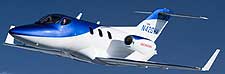
| With the perennial rivalry between Boeing and Airbus continually grabbing the headlines, the growth of the business aviation sector in general, and the advent of the 'very light jet' (VLJ) in particular, has happened away from the spotlight. It took the launch of auto manufacturer Honda's sleek VLJ, the HondaJet, at the Oskosh air show in the US this year, as well as the type certification of the Eclipse 500, to refocus attention on this business phenomenon. "What I have in my hand is probably the most significant piece of paper in America today, a piece of paper that will truly change the face of aviation," said US Federal Aviation Adminstration (FAA) administrator Marion Blakey, just before handing the provisional Type Certificate for the Eclipse 500 VLJ aircraft, to Vern Raburn, Eclipse Aviation's president and CEO. Eclipse Aviation Corp will now become the first company in the world to deliver such jets to customers. Eclipse's achievement has been seven years in the making. Accepting the certificate from Blakey, Eclipse CEO Raburn was no less optimistic: "This sector of the marketplace is attracting more interest, more investment and more activity than any other place in aviation," he said. Eclipse already has nearly 2,500 orders from customers, worth a total of $3.8 billion. With VLJs now set to arrive at airfields around the world in thousands, such numbers are set to alter the face of business travel. The Microjet VLJs or microjets are small planes whose interiors are the size of a minivan's, and are targeted at organisations that want to diversify their corporate fleets, at individual pilots who want to fly their own jets and a budding air-taxi industry that seeks to link small and big airports. Air-taxi services are targeting business travellers who would not like to waste a lot of time shuttling in and out of hub airports. (See: Fractional Jet Ownership) Most of the VLJs are designed to carry between five to seven passengers along with a pilot, and depending on the load, have a range of between 900-1,400 miles. A VLJ will cost between $1.5 million to $3 million, as compared with corporate jets, whose prices range from $4.5 million to $50 million. VLJs are also less expensive than most of their turboprop competitors. According to Eclipse calculations, a one-way, 400-mile trip on a VLJ, with four passengers on the plane, could cost about $1 a mile per passenger. Some trips could, at most, cost about that of a first-class airline ticket. An identical trip on a corporate jet could cost more than $10 a mile. (See: Business aviation aircraft) The European Business Aviation Association and Convention (EBACE) in Geneva, the Farnborough International air show in the UK and the Oshkosh air show in the US held around the last week of July this year, all reflected in full measure the buoyant growth and interest in executive jet travel. The Farnborough show took special care this year to position the business aircraft section at the exhibition, realizing fully well its growing importance. The Oshkosh air show witnessed the Eclipse 500 receiving its type certification and Honda unveiling its plans for the HondaJet. (See: New birds) Rise of business aviation The reasons for this remarkable growth are not far to seek. According to Brazilian aircraft manufacturer Embraer's senior vice-president, Luis Carlos Affonso, a burgeoning world economy, the reduction in available first-class airline seats and increased door-to-door time for those using commercial airline services are the factors responsible for the upswing in the business aviation sectors fortunes. The last two of these reasons arise from the fact that as bigger airlines continually lower their fares, more and more people are beginning to fly. Congested terminals at hub airports, and lengthy check in periods, thanks to heightened security, are all taking their toll. Passengers are fed-up with the hub and spoke systems. As a result high net worth individuals and business executives are increasingly turning to private charter, or their own aircraft, to meet their travel requirements. Significantly, the business-jet industry points out, at least a quarter of all business jet flights are made to places with no commercial air service. Business flights access about 5000 domestic airports in the US, for instance, as compared to fewer than 600 that are served by commercial airlines. Two business aviation industry forecasts - Honeywell Aerospace's 12th Annual Business Aviation Outlook and Rolls-Royce's The Market for Business Jets, 2003-2022 – project continuing demand for new business aircraft. While the Honeywell forecast predicts that customers will accept approximately 7,700 units valued at $115 billion between 2003 and 2013, Rolls-Royce forecasts that 13,948 new aircraft will be delivered between 2003 and 2022. Other than the reasons already pointed out, both the surveys point to new-generation aircraft designs offering capabilities and efficiencies previously unavailable, including the VLJ, a wholly new class of aircraft, as a reason for the growth in the sector. They also say that more stringent operating rules will progressively make older aircraft obsolete and create demand for a new generation. Embraer's Affonso says that he expects a jump in annual business aircraft deliveries from 749 last year to a projected 1,100 in 2015. Interestingly, as per his estimates, about a quarter of these deliveries will be VLJs. According to FAAs Marion Blakey, as many as 5,000 VLJs are expected to go into service by 2017. (See: Bang for the buck) The Aerotropolis The rise of business aviation industry has also to be seen as part of a larger picture – the overall growth of the aviation sector around the world. Research by John Kasarda, a professor at the University of North Carolina's Kenan-Flagler Business School, and as quoted in an article (Rise of the Aerotropolis, Fast Company, July 2006), would show that in the last 30 years global GDP has risen 154 per cent, and the value of world trade has grown 355 per cent. In the same period the value of air cargo has climbed a whopping 1,395 per cent. Kasarda points out that 40 per cent of the total economic value of all goods produced in the world, though comprising only one per cent of the total weight, is now being shipped by air, with the rest slow-boating it to their destination. For Kasarda, these figures not only reflect the rising importance of the aviation sector but also reveal the nature of global competition as it will take place in the future. Airpower, he says, is now effectively a part of global production systems. For a visionary like Kasarda, it will be the coming together of urban planning, airport planning and business strategy that shall determine the game in the future. His vision of an airport centric city is now dubbed as the aerotropolis. The term is derived from a combination of the words aero plus metropolis, denoting a large city. It's also called an aviation city or an airport city. In its purest form, the aerotropolis is an economic hub that extends out from a large airport into a surrounding area that consists mostly of distribution centers, office buildings, light manufacturing firms, convention centers, and hotels, all linked to the airport via roads, expressways (aerolinks), and rail lines (aerotrains). Bangkok's new $4 billion mega-airport, Suvarnabhumi, will handle more than 100 million passengers a year eventually, about as many as JFK, LaGuardia, and Newark airports combined. Within 30 years, it shall be the hub around which a city of 3.3 million citizens will have emerged. Hong Kong's Chek Lap Kok airport already has a mini-city stationed on a nearby island for its 45,000 workers, and the city is basing its future strategy for growth around it. On the Chinese mainland, construction is afoot on the Beijing Capital Airport City, a $12 billion master-planned city of 400,000. South of Seoul, New Songdo City is being built on a man-made peninsula in the Yellow Sea, at an estimated cost of $20 billion, and will be a metropolis of 350,000 people. Dubai is constructing the world's largest aerotropolis, the Dubai World Central (DWC), at an estimated cost of $33 billion. When completed, the DWC will have more than twice the capacity of Frankfurt's airport and a permanent population of 750,000, almost as large as Stockholm. Hey, not on my lap… In the meanwhile, VLJ makers are already positioning their products vis-a-vis each other, much like automobile makers in the B-segment. Embraer's new VLJ, the Phenom100, for instance, will have an asking price of $2.85 million and provide 55cuft of baggage space. This, says Embraer, would dwarf that of the Eclipse 500 and Adam A700 by about 30cuft, the Citation Mustang by nearly 20 cuft and the Beech King Air C90GT by seven cubic feet. Wow! But then, if one is paying $2.85 million for a pair of wings, every cuft of space matters, doesn't it? | Fractional Jet Ownership Fractional Jet Ownership is sometimes referred to as Fractional Jet Leasing or Jet Time Sharing. A company or individual buys, or leases, a fractional interest in one aircraft, much as they would acquire a partial interest in one condo unit. Such an aircraft or another similar or identical aircraft may then be used a certain number of hours or days per year just as a condo owner can use the condo a specified number of days or weeks per year. In general, a buyer or lessor normally buys or leases a 1/8th interest in an airplane, and can have up to 100 hours per year of usage as part of the purchase. The cost of the 1/8th share depends on the airplane chosen. This may vary with a 1/16th interest, which would include 50 hours, or a 1/4th interest, which would include 200 hours. Each deal is separately negotiated and some provide facilities for buyback or cancellation. The economics of each situation differs depending on the number of people who will use the aircraft, the value of their time to the company, and the amount saved in airline tickets, hotels, etc. The fractional interest buyer or lessor will get a "turnkey" operation of aircraft, crews, scheduling, and maintenance on demand. With an operator such as NetJets, the pioneer in fractional jet ownership, customers can access to over 5,000 airports worldwide and a fleet of 14 different jet types.
Origins In 1965 William P. Lear Jr. and General Paul Tibbets Jr. joined the company then known as Executive Jet Aviation. In 1986, a subsidiary known as NetJets was created. Richard Santulli created the concept of selling fractional ownerships in business jets to companies and individuals who required business jet transportation, but for whom charters or ownership were a burden. This programme was begun in earnest in 1987 and the NetJets concept of fractional ownership was born. In 1998, Warren Buffet's Berkshire Hathway, Inc. bought the company for $725 million and is now a major backer of the company now known as Executive Jet. | | Business aviation sector According to Mid America Regional Council's (MARC) Regional Aviation System Plan Update 2005, the popularity of business aircraft has increased as more companies realize the benefits arising from this business tool. According to the update, the worldwide jet fleet at the end of 2003 was 12,974 aircraft, more than double the fleet size in 1986. MARC's update says, "Most of the increase in general aviation aircraft use occurs with jets, the fastest-growing category of general aviation aircraft. The active fleet and hours are up 4.3 per cent and 7 per cent annually, respectively. The FAA said the large increases are due to the expected increases in both the fractional-ownership fleet and its activity levels. Utilization of fractional-ownership aircraft averages approximately 900 hr annually, compared with only 325 hr for all business jets." According to US National Business Aviation Association figures the number of companies operating business aircraft in the United States has grown more than 60 per cent from 6,584 companies operating 9,504 aircraft in 1991 to 10,661 companies operating 15,879 aircraft in 2003. During 2003, 14,555 operators flew 23,121 turbine-powered business aircraft worldwide. More than 75 percent of the operators (10,982) and 72 per cent of the aircraft (16,650) were located in North America. Europe was home to the second largest concentration of operators (1,255) and aircraft (2,378), while South America ranked third in both categories, with 979 operators and 1,533 aircraft. The remaining 9 per cent of the operators and 11 percent of the aircraft were scattered throughout Africa, Asia, Central America, the Middle East and Oceania (which includes Australia and the Pacific islands). NetJets, a subsidiary of Warren Buffet's Berkshire Hathaway, operates a quarter-million flights annually to 140 countries. Its fleet includes hundreds of aircraft ranging from seven-seat Cessna Citations to 18-seat Boeing Business Jets. Flexjet is a division of aircraft manufacturer Bombardier Aerospace. Fleet ranges from a seven-passenger, 1,400-mile Learjet 31A to a nine-passenger Challenger 604 with intercontinental range. Flight Options, now merged with Raytheon Travel Air in 2001, has more than 200 new and used planes. CitationShares, a joint venture of Cessna Aircraft and TAG Aviation, has a fleet of all Citation jets, including five-passenger CJ1s, seven-passenger Bravos and eight-passenger Excels. UK-based JetSet Air plans to introduce 50 Eclipse 500 VLJs and is promising low cost, private jet services. The company says that its goal is to be the easyJet of the business aviation market. Another new start up, Geneva-based JetBird has announced an order for 50 Phenom 100 aircraft from Embraer, plus 50 options (which could be for the 100 or the larger Phenom 300). JetBird's deliveries will commence from April 2009. JetBird will initially base the aircraft in Zurich, where it plans to offer low-cost, on-demand jet services. DayJet Corp., a Florida based US start-up, is looking to get into the air-taxi market and has ordered 300 Eclipse jets, which will be the backbone of its fleet. | | New birds Embraer has announced a long range VIP version of the Embraer 190, dubbed the Lineage 1000. Priced at $40 million-plus and with a 4,000 plus nautical mile (nm) range the jet will uniquely have 5.5 degree capability for runway restricted airports. Its customers are the ones who are shopping for the Airbus A318 Elite or the Boeing Business Jet. Embraer does not yet have a launch customer for the Lineage 1000. Embraer has already evolved its 50-seat Embraer 145 regional jet into the Legacy business jet. Embraer's arch rival Bombardier, already one of the top three business jet players, is promoting its new Challenger 800 series as corporate shuttles (the 870 and 890 are based on its CRJ700 and CRJ900 regional airliners, which compete for the same market as the Embraer 170 and 190.) | | Business aviation aircraft Eclipse Aviation's Eclipse 500 is priced at $1.4 million, can seat five or six people, comes without a restroom and has an interior designed by BMW. It has already begun entering service, with initial deliveries being made to customers as of July. Adam Aircraft Inc.'s Adam A700, which can seat six or seven passengers and comes with a restroom, is priced at $2.25 million. Adam has taken about 340 orders for the jets and is expected to begin delivering them next year. The aircraft is due to be certificated by the year end. The very innovative HondaJet expects to complete type certification in 3-4 years. Key HondaJet innovations include a patented over-the-wing engine-mount configuration, a natural-laminar flow (NLF) wing and fuselage nose, and an advanced all-composite fuselage structure. HondaJet will achieve far better fuel efficiency, larger cabin and luggage space and higher cruise speed than conventional aircraft in its class. So far, the prototype HondaJet has achieved an altitude of 43,000 feet and a speed of 412 knots. The Beech King Air C90GT is priced at $2.95 million. The C90GT is marketed by Raytheon as a twin-turboprop alternative to the VLJs. Embraer's Phenom 100 will enter service in mid-2008, and will be priced at $2.85 million. According to Embraer, Phenom jets will offer premium comfort, outstanding performance and low operating costs. Phenom 100's 55 cu ft of baggage space dwarfs those of its competitors. The Phenom is dubbed a VLJ because it weighs less than 10,000lbs. It also boasts of larger cabin height and width than others in its category. The earliest available delivery slot for the Phenom 100 is May 2010, and Embraer is considering increasing production rates for the VLJ in 2009 and 2010. Gulfstream Aerospace's G450, able to fly eight passengers non-stop for 5000 miles, will come with a price tag of $33 million. Cessna has entered the VLJ market with the Mustang, which sells for $2.4 million, seats five plus the pilot, and is toilet-equipped. Cessna has a backlog of 240 orders. Like the Adam A700, the Mustang is due to be certificated by the year-end.
| | Bang for the buck New aircraft in the business-jet world come in "green." This means that a plane comes with an interior that is just bulkheads with exposed insulation and steel-plate floors. It's a plane that requires "options" to be exercised. On a big business jet this could easily set you back another $US3 million or $US4 million. Gven the size of the orders, quite naturally, there is an industry that caters to doing the interiors of business jets. The options include top quality carpets, cabinets and panels, with mahogany, cherry and other expensive, tasteful veneers. Muted lighting and top drawer communications, which includes in-flight phone service and email and internet accessibility, are a must. Entertainment systems will include flat-screen video displays, surround sound and movie selections. Seating arrangements will require sleeper seats and divans upholstered with top-quality leather, while lavatories often include walk-in showers in the top-line planes like the airliner-sized Boeing Business Jet and the Airbus Corporate Jetliner. Security systems are being incorporated, which may well include onboard defences against surface-to-air missiles! 24-carat gold plating is also in heavy demand, mainly for trim, plumbing fixtures, drawer pulls and other accessories. The ACJ Prestige, a super-deluxe model of the Airbus Corporate Jetliner, costs $US43 million green. The customised cabin, according to its promotional material, is built with the idea that it should look more like "the interior of a multi-million-dollar home than the interior of a multi-million-dollar airplane." |
|
|