|
Mumbai:
According to a report on the global economic outlook
published by Standard & Poor's Ratings Services
in March 2007, global economic growth is disproportionately
riding on India and, to an even larger degree, China,
both of which have seen energy demand rise sharply.
As
the report, titled On The Road To Big Profits In
China And India, Global Automakers May Hit Some Bumps
points out, automakers' hopes are riding particularly
high in China due to the significant investments already
made in this market.
Forecasts
by J D Power and Associates (which, like Standard &
Poor's, is a unit of The McGraw-Hill Companies) suggest
that China could overtake Japan to become the world's
second-largest automotive market as soon as 2007. It
is already the world's fourth-largest manufacturer of
automobiles after North America, Western Europe, and
Japan, and the third-largest producer of commercial
vehicles behind the US and Japan.
However,
despite promising high returns, the burgeoning auto
markets of China and India carry high credit risks for
foreign automakers, not least because of intense competition
to maintain a foothold in these markets, says a report
published today by Standard & Poor's Ratings Services.
The
report points out to the major differences between the
Indian and the Chinese markets. In India, the second
fastest-growing auto market, passenger cars sales grew
by 16 per cent in 2006 compared with just 8 per cent
a year earlier, fueled mainly by increases in the small-car
segment boosted by tax benefits, new model launches,
and greater access to consumer financing. Nevertheless,
the international OEMs' chances of gaining from this
are being dampened by the predominance of cheaper, locally
manufactured motorised three-wheelers, which still hold
nearly 80 per cent of India's total vehicle market.
The
competition in the Chinese auto industry is more intense
than in India, which is still dominated by a few large
players, a situation, which the report says, is bound
to change as a result of the current attempts of all
international OEMs to gain a greater foothold in this
market.
In
contrast in the more developed Chinese market, every
major international manufacturer is already present
through imports and, increasingly, with local assembly
and production plants, which are generally owned in
conjunction with local joint-venture partners.
This
has enabled foreign players to capture about 70 per
cent of the Chinese market. And. although the country
has more than 100 auto manufacturers, only a few companies,
including the market leader First Automotive Works Group
(FAW), produce more than 500,000 units per year, including
commercial vehicles.
On
the other hand, the report says, "the fledgling
Indian car market" is significantly more concentrated
than China's, although foreign players are increasingly
making inroads. They are currently working at setting
up or expanding their existing production bases in India,
but progress is slow and they must avoid the overcapacity
already prevailing in China to preserve overall satisfactory
profitability in the long run.
Maruti
Udyog Ltd, which is 54-per cent owned by Suzuki Motor
Corp, dominates with a market share of about 49 per
cent. At present, it specialises in the small-car segment,
but it has strong plans to penetrate the medium- and
large-vehicle segment in the near future.
The
next-largest players are Hyundai Motor India Ltd., a
subsidiary of Korean Hyundai Motor Co., and India's
own Tata Motors Ltd. In the year-to-date November 2006,
Tata Motors held third position in midsize entry-level
sedans (Indigo) and in the compact-car segment. Finally,
Honda Siel Cars India Ltd., a joint venture between
Japanese Honda Motor Co. Ltd. and Siel Ltd., is the
fourth-largest.

"China
represents a major factor in foreign OEMs' profitability
expectations, especially those with the largest presence
such as Volkswagen and General Motors," said Standard
& Poor's credit analyst Maria Bissinger. "It
will take longer for the automakers to reap rewards
from the Indian auto market, on the other hand, as they
are still in the initial stages of the investment cycle."
Competition has severely dented the OEMs' market shares,
says the report. That of Germany's Volkswagen AG, which
gained almost 60 per cent of the market in the mid-1990s,
has fallen to 18 per cent in 2006. Nevertheless, VW's
sales in absolute numbers are growing steadily, and
the 711,000 units sold by Volkswagen Group in China
in 2006 represented 12.4 per cent of the group's global
sales volume.
VW
made a loss in China in 2005, but recovered to a modest
profit of €108 million in 2006. And despite its
established production base, investments in China remain
high for the group: Between 2007 and 2009, it will invest
€1.9 billion in China, although this will be financed
from internal funds of its local joint ventures.
Similarly, the book value of investments in China by
General Motors Corp, which is number two in the Chinese
market through six joint ventures, amounted to about
$2.8 billion in the course of the past three years.
Profitability,
as measured by GM's share of its Chinese affiliates'
net income, amounted to a constant $300 million per
year over the past two years, which represents a meaningful
contribution to GM's net income of $1.2 billion in the
Asia-Pacific region in 2006, and stands in sharp contrast
to its huge net loss of $4.6 billion in North America
during the same period.
As
the Chinese auto market consolidates, the strongest
domestic players are already beginning to pose a competitive
threat to the established automakers. Already in 2006,
export volumes of Chinese-made vehicles (including CKD)
reached 340,000 units although in dollar terms
the value of exports still lags.
While
China has been the key focus of OEMs' capital expenditures
in recent years, the bulk of the production capacity
build-up has been completed and fresh investments will
be more in the nature of add-ons.
On
the other hand, capacity build-up in India will require
higher overall investments by foreign OEMs if they want
to seriously participate in growth. Furthermore, high
import tariffs make local production a prerequisite
to reach a meaningful market share in India.
In
India, foreign automakers, as well as their domestic
competitors, have strong capacity expansion plans. Forecasts
suggest that production capacity will increase by more
than 80 per cent next three years. This means that the
capacity utilisation rate, which was a robust 75 per
cent in 2005, is likely to deteriorate significantly
until the end of the decade to levels similar to China,
currently with capacity utilisation rates somewhat below
60 per cent.
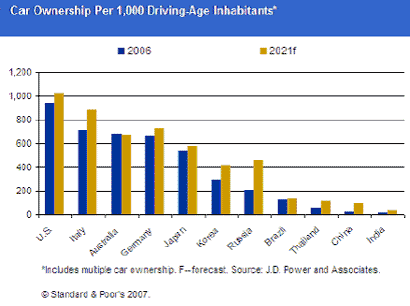
In
India and China, with populations of more than a billion
each, fewer than 20 in 1,000 driving-age inhabitants
owned a car in 2006. This compares with 900 car owners
per 1,000 inhabitants in the US. With purchasing power
forecast to grow above 10 per cent per year in China
and by more than 7 per cent per year in India over the
next five years, car sales are expected to grow. enormously.
|