|
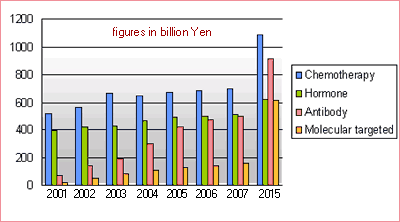
Japan''''s second largest drug maker Astellas will pay $537 million for US biotech firm Agensys to accelerate its antibody research, especially against cancer. Japan''''s second largest drug maker Astellas has agreed to acquire US biotech firm Agensys as part of its plan to accelerate its antibody research, especially in the field of cancer. The price: $537 million, including an upfront payment of $387 million and a later payment of up to $150 million conditional on various development targets. Astellas, itself the result of a 2005 merger between two Japanese companies, Yamanouchi Pharmaceutical and Fujisawa Pharmaceutical, will acquire Agensys through its US subsidiary. The purpose of the acquisition is to catapult itself to the forefront of the world''''s antibody drug research business. The Astellas-Agensys combine is considered to have at least seven potential cancer treatments in the pipeline. In Japan, the country''''s number one drug producer Takeda Pharmaceutical and fourth-ranked Eisai have already been acquiring biotechnology assets. The attraction of the protein-based biotech products is their rapid growth, which is reported to be as much as 14 times that of traditional chemical compounds. As the biotech action hotted up, Astellas was not sitting on its hands either. In March 2007 it bought a non-exclusive licence to VelocImmune technology from Regeneron and access to a phage display library from MorphoSys. Astellas expects (on the basis of IMS Health data) that cancer drug sales will double between 2005 and 2015 to over $32 billion. It believes that a bulk of this growth will come from antibodies and molecular targeted drugs, and counts on these two segments to account for close to $9 billion of that growth. Astellas president and CEO Masafumi Nogimori says, "Agensys will be the cornerstone of our biologics efforts and an integral component of building our oncology efforts within our franchise." | | 2001 | 2002 | 2003 | 2004 | 2005 | 2006 | 2007 | 2015 | | Chemotherapy | 519 | 567 | 666 | 646 | 671 | 687 | 701 | 1,083 | | Hormone | 391 | 421 | 428 | 463 | 496 | 501 | 517 | 620 | | Antibody | 70 | 139 | 193 | 296 | 420 | 468 | 503 | 913 | | Molecular targeted | 22 | 51 | 83 | 106 | 129 | 138 | 160 | 615 | According to the Agensys management, the US company is developing a pipeline of therapeutic fully human monoclonal antibodies to treat solid tumour cancers based, and "has discovered and validated a rich portfolio of novel, clinically relevant cancer targets to 14 different cancer types that have been carefully selected to enable development of new effective therapeutics with fewer and less severe side effects." According to the company, its cancer targets must meet these criteria: 1. A novel molecule and/or a novel utility in cancer; 2. Expression in a significant percentage of patients'''' specimens; 3. Limited expression in normal vital tissues; and 4. Structural and functional features suitable for therapeutic intervention. The company is generating fully human antibodies to multiple targets from its portfolio, including those directed to prostate, kidney, bladder, colon, lung, ovary and pancreatic cancers. Its portfolio also contains multiple validated targets for small molecule and vaccine products that it intends to develop through partnerships with pharmaceutical and biotechnology companies. With the acquisition, Astellas scientists will be able to use the targets identified by Agensys in their small molecule drug discovery work. That would be something like 30 different targets across 14 different cancer types. The Astellas management sees many synergies developing with Agensys (see chart below). Agensys already has one antibody at the clinical stage, and has a clinical-scale GMP manufacturing facility to produce enough of the drug for phase 1 and early Phase 2 clinical trials. The manufacturing plant has purification instruments and equipment for cell culture.
 The US company''''s most advanced drug candidate is AGS-PSCA, a fully human monoclonal antibody targeting prostate stem cell antigen found on tumour cells from the majority of patients with all stages of prostate, pancreatic and bladder cancers. It has two other antibodies in phase 0 and eight others at the pre-clinical testing stage. Agensys has also licensed the ''''linker-toxin technology'''' from Seattle Genetics in order to be able to generate antibody-drug conjugates.
|