
An analysis of CRISIL's rating trends indicates that the credit quality of CRISIL-rated corporates is stronger than it has been at any time in the recent past. This bears out the predictions made in CRISIL's October 2004
Ratings Round Up. An improvement in credit quality has been witnessed across all sectors covered by CRISIL.
The analysis also indicates a sustainable improvement in the balance sheets of CRISIL-rated companies, and predicts a continuation of strengthened credit quality over the medium term. Although high oil prices or a slowdown in global economy might lead to deceleration in growth, CRISIL expects the strong credit quality of Indian corporate to hold through the medium term.
MCR at all-time high with improving corporate credit
CRISIL's modified credit ratio (MCR) is defined as the ratio of upgrades plus reaffirmations to downgrades plus reaffirmations. Given that CRISIL's rating portfolio encompasses all the key sectors of the Indian economy, and includes most of the top players in each segment, CRISIL's MCR is a reliable indicator of systemic credit quality trends, and a measure of underlying business fundamentals. In FY05 (April 2004 to March 2005), CRISIL's annual MCR for long-term ratings hit an all-time high of 1.16, passing the previous high of 1.06 recorded in FY95. This improvement reflects 26 upgrades and 2 downgrades in CRISIL's long-term ratings portfolio in FY05. (See table at the end)
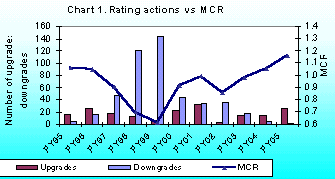
Downgrade rate touches 10-year low
CRISIL's downgrade rate - defined as the ratio of total downgrades to outstanding ratings - reached a 10-year low of 1.32 per cent, breaching the previous low of 1.99 per cent recorded in FY95. However, in contrast to FY95 when no default was recorded, one default was observed in CRISIL's long-term ratings portfolio in FY05.

Expected improvement materialise
CRISIL's rated portfolio includes a wide range of sectors, and covers the key players in each sector. This makes the CRISIL MCR a sensitive measure of industrial performance and prospects. As predicted in the CRISIL Ratings Round-Up of October 2004, the performance of the industrial sector continues to be strong. Chart 3 below shows that the growth in the Index of Industrial Production, (general), at 8.45 per cent, scaled a 10-year high in FY05; this is in keeping with the indications available from the CRISIL MCR. This growth in IIP (general) is also reflected in improvements in MCR of all the key sectors of the economy, as will be discussed later in this document.

Historically, GDP growth has also mirrored MCR. However, in FY05, the GDP growth rate was impacted by a sharp decline in agricultural growth, which dropped to 1.1 per cent from 9.6 per cent in FY04 due to poor monsoons. This has had no significant impact on the growth of the industry and services sectors, which are more strongly linked to corporate performance, and therefore reflected in MCR trends.

Source: CRISIL Centre for Economic Research
Broad-based improvement

Key sectors of the economy - manufacturing, infrastructure and finance - recorded MCRs of more than 1 for the second consecutive year, indicating continued buoyancy. The manufacturing and finance sectors reached 7-year high MCRs of 1.13 and 1.27 respectively.
Of the 13 upgrades in the manufacturing sector, the automobile industry accounted for three, with the remainder being distributed across sectors. This underscores the broad-based improvement observed so far in manufacturing sector performance. The two downgrades in the manufacturing sector were NIIT Technologies (rating downgrade occurred subsequent to its de-merger from its parent, NIIT Ltd) and Escorts Ltd (on account of problems following a delay in realising proceeds on the sale of investments in telecom ventures - Escotel Mobile Communications and Escorts Telecom Ltd. - to Idea Cellular).
Demand driven growth in manufacturing
Key industries in the manufacturing sector have shown strong performance, driven by both consumption and investment-led domestic demand. Continued spending on road projects, a buoyant construction sector, and growth in automotive and consumer durable sectors (led by the availability of low-cost retail financing), drove demand for cement and metals. On the other hand, sectors such as pharmaceuticals and auto ancillaries, leveraging global cost competitiveness, registered impressive export performances despite the rupee's appreciation against the US dollar.
This strong demand, coupled with only modest capacity addition in the recent past, resulted in high capacity utilisation across key industries (see charts 6 and 7 below). Additionally, initiatives on cost cutting and value engineering, coupled with lower finance costs, have contributed to sustainable improvements in competitiveness across sectors. A continued global cyclical upturn in commodities, notably metals and petrochemicals also significantly boosted corporate bottomlines. CRISIL-rated corporates have used this phase of high accruals to strengthen their balance sheets, and are thus better placed to cope with incipient margin pressures, and with any future slowdown. CRISIL therefore expects sustained strong credit quality in the corporate sector.
Going forward, CRISIL believes that high oil prices and potential slowdown in global economy could play a role in muting the buoyant growth observed so far. Sustainable improvements in corporate balance sheets will, however, buttress the underlying credit quality of the rated corporate portfolio, allowing corporates to weather periods of weaker performance. CRISIL therefore expects the credit quality of its rated corporates to demonstrate steady performance going forward.


Emerging regulatory and policy clarity in infrastructure sector
The infrastructure sector saw three upgrades and no downgrades during FY05. Emerging regulatory and policy level clarity, particularly in the power and telecom sectors, has reduced uncertainties in the sector, and spurred investment. The road sector witnessed a high level of activity with some annuity projects under the NHDP programme becoming operational. Mining companies too witnessed an upturn in volumes and prices, largely driven by the growth in demand from China.
As with the corporate sector, CRISIL believes these growth trends may not sustain at the same levels going forward. For rated companies in the sector, credit quality is expected to remain stable over the short to medium term, reflecting favourable structural factors described above.
Continued improvement in operating efficiency in finance sector
With an MCR of 1.27, the financial sector showed the most pronounced upward trend among the three sectors covered in this study. Of a total of 10 financial sector upgrades, five were from the banking industry, which witnessed no downgrades. While retail loan books were burgeoning for the last few years, banks witnessed healthy corporate loan book growth during FY05. Improving economic performance and an upturn in the commodity cycle also helped reduce loan losses and provisioning requirements. However the key reason for upgrades in banking sector was CRISIL's reassessment of the central government's support available to public sector banks; this reassessment has also led to upgrades of bank subsidiaries.
CRISIL believes that in FY06, increasing efficiency of operations and the ability to pass on increased cost of funds to borrowers, will protect the earnings of its rated financial sector entities. Additionally, in CRISIL's opinion, loan loss levels will be contained as asset quality is unlikely to deteriorate. CRISIL therefore expects the current high levels of credit quality of these entities (96.2 per cent of CRISIL's financial sector ratings are 'AA' or above) to be sustained going forward.
Anticipated upturn in the investment cycle has occurred
CRISIL's Ratings Round Up of April 2004 predicted increased investments in capacity. An analysis of over 200 manufacturing and infrastructure companies in CRISIL's rated portfolio indicates that the expected corporate investment in new capacity is indeed taking place, as evident from Chart 8. This uptrend in the investment cycle is driven by