labels: Economy - general, RBI
RBI cuts short-term rates; keeps Bank Rate, CRR unchanged news
21 April 2009

The Reserve Bank of India today cut its key short-term (repo and reverse repo) rates by 25 basis points each to help bank lower lending rates further and kick-start growth in key sectors of the sagging economy.
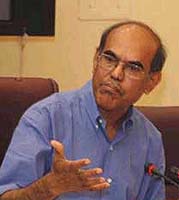
D Subbarao, Governor, Reserve Bank of IndiaThe RBI, however, kept the Bank Rate – the rate at which banks lend longer-term - and the cash reserve ratio for scheduled banks unchanged at 6.0 per cent and 5.0 per cent, respectively.

The repo rate, at which the Reserve Bank of India (RBI) injects liquidity into the banking system, will be cut from 5.00 per cent to 4.75 per cent, and the reverse repo rate, at which it absorbs excess cash from banks, will be reduced from 3.50 per cent to 3.25 per cent, with immediate effect.

The cash reserve ratio (CRR) of scheduled banks has been retained unchanged at 5.0 per cent of net demand and time liabilities (NDTL), the RBI said in its annual monetary policy statement.

The Reserve Bank has the flexibility to conduct repo/reverse repo auctions at a fixed rate or at variable rates as circumstances warrant.

''The Reserve Bank retains the option to conduct overnight or longer term repo/reverse repo under the LAF depending on market conditions and other relevant factors. The Reserve Bank will continue to use this flexibly including the right to accept or reject tender(s) under the LAF, wholly or partially, if deemed fit, so as to make efficient use of the LAF in daily liquidity management,'' the central bank said.

The Reserve Bank also cut its economic growth estimate for fiscal 2008-09 to 6.5 to 6.7 per cent, and forecast growth of around 6.0 per cent in 2009-10.

"Any upturn in the growth momentum is unlikely in view of the projected contraction in global demand during 2009, particularly the decline in trade," the central bank said.

The Reserve Bank expects banks to pass on the rate cuts to customers and also take measures to reduce deposit rates as well.

"There is scope for the overall interest rate structure to move down within the policy rate easing already effected by the Reserve bank," it said, adding its latest rate cut reinforced the case.

The RBI has now cut its short-term lending rate by 425 basis points in six installments since 20 October.

The BSE Sensex and the rupee ended firmer, while government bond yields eased to two-month lows.

The RBI, however, said managing large government borrowing in 2009-10 in a non-disruptive manner would be a major challenge, and said it would used a mix of monetary and debt management tools to ensure this was done smoothly.

''The global financial situation remains uncertain and the global economy continues to cause anxiety for several reasons.  There is as yet no clear estimate of the quantum of tainted assets, and doubts persist on whether the initiatives underway are sufficient to restore the stability of the financial system,' the RBI noted. 

''Many major central banks have nearly or totally exhausted their conventional weaponry of calibrating policy interest rates and are now resorting to unconventional measures such as quantitative and credit easing.  Given the erosion of the monetary policy transmission mechanism, there are concerns about when and to what extent monetary response, admittedly aggressive, will begin to have an impact on reviving credit flows and spurring aggregate demand,'' it added.  

India too has been impacted by the crisis despite a healthy financial sector and low exposure to tainted assets, and by much more than what was expected earlier, the RBI noted.

For the first time in seven years, India's exports declined in absolute terms for five months in a row during October 2008-February 2009.  Demand for bank credit also slackened despite comfortable liquidity in the system.  Dampened demand has dented corporate margins while the uncertainty surrounding the crisis has affected business confidence. 

The index of industrial production (IIP) has been nearly stagnant in the last five months (October 2008 to February 2009), of which two months registered negative growth.  Investment demand has also decelerated.  All these indicators suggest that growth will moderate more than what had been expected earlier, RBI said.

RBI had projected real GDP growth of 8.0-8.5 per cent for 2008-09 in its annual policy statement in April 2008 at a time when the IMF had projected the global growth in 2008 at 3.7 per cent. Over time, the economic prospects globally, including in India, deteriorated rapidly.  The RBI, too, revised downward its growth projection for India for 2008-09 to 7.5-8.0 per cent in its mid-term review (October 2008) and further down to 7.0 per cent with a downward bias in the third quarter review (January 2009).

''The downside risks have since materialised and the GDP growth for 2008-09 is now projected to turn out to be in the range of 6.5 to 6.7 per cent,'' RBI said.


 search domain-b
  go
 
RBI cuts short-term rates; keeps Bank Rate, CRR unchanged