labels: Power, Defence production
Indo-French civil N-pact likely to be signed during PM's France visit news
29 September 2008

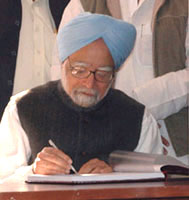
Marseilles: Indian prime minister Manmohan Singh indicated over the weekend that the India-France civil nuclear cooperation agreement could likely be signed in Paris on 30 September, when he commences his official visit to France.

''We have already initialled the framework agreement in civil nuclear matters. It will certainly come up for review and possible signature during my visit,'' Singh said when asked by reporters accompanying him whether he expected the nuclear agreement to be signed during his two-day tour to Paris.
The framework agreement was initialled during French president Nicolas Sarkozy's visit to India in January this year.

Observers point out that the presence of Atomic Energy Commission chief Anil Kakodkar also indicated that the likelihood of a Indo-French nuclear pact being signed was high.

Should the accord be signed, it will become the first such agreement by any country after a crucial waiver being granted by the Nuclear Suppliers Group (NSG). The waiver exempts India from being subject to customary rules and regulations under which NSG members are prevented from trading in nuclear fuel and technologies with non-NPT signatories. India is one of only three such nations, along with Israel and Pakistan, not to have signed the Nuclear Non-Proliferation Treaty.

India is currently awaiting passage of the Indo-US nuclear civil cooperation treaty, which has to be cleared by the US Senate to become an Act. It has already received necessary approval form the US House of Representatives.

It is being surmised that India may well be awaiting passage of the Bill by the US Senate before signing agreements with any nation. Indeed it has already assured the Americans earlier that they would not be dis-advantaged in any way through any delay in the passage of the Bill by the US Congress.

The US Congress, currently embroiled in the handling of unprecedented economic crisis, is preparing to pass a $700 billion bailout plan for financial institutions. This pre-occupation has led to unexpected delays in the passage of the Indo-US nuclear Bill.

Meanwhile, the prime minister said he was looking forward to his meeting with Sarkozy, who as chairperson of the European Union, will be presiding over tomorrow's Indo-EU summit at Marseilles.

Singh and Sarkozy are expected to discuss trade, investment, defence, civil nuclear cooperation and high technology. The two countries may also initial a bilateral social security pact. Under the planned agreement, more than two lakh Indians in France will be eligible to avail social security benefits.

The Union Cabinet had on September 18 approved the terms for signing the pact.

Another agreement would concern civil aviation, through which carriers from both nations are expected to benefit form relaxation of rules governing the sector.

In the defence sector, French companies, including Thales SA and Dassault Systemes are in discussions with India to upgrade 51 Mirage combat jets from early 2009. The technical part of these talks have already been concluded and all that remains to be finalised is the value of the contract.

The prime minister will also address an Indo-EU business summit in Paris on 30 September before returning home at the end of his 10-day visit to the US and France.

Meanwhile, France, the world's leading generator of nuclear power, producing 80 per cent of electricity from atomic energy, has said it is ready to offer its latest EPR technology to India.

Ahead of his talks with Singh, Sarkozy said the prospects of cooperation between France and India in the civil nuclear field are ''very promising'' considering his country's expertise, long tradition of cooperation with New Delhi and an atmosphere of trust.

''This visit holds a special meaning for me. We will launch our civil nuclear cooperation which will become a cornerstone of our partnership,'' he said.

India and France initialed the Framework Agreement for Civil Nuclear Cooperation in January but could not sign it pending a waiver from the 45-nation Nuclear Suppliers Group.

Describing the India-IAEA Safeguards Agreement and the NSG waiver for India as ''historic landmarks'', Sarkozy noted how France and particularly he had worked for ensuring exemption to India to conduct civil nuclear trade.

''France has been working towards this over the past ten years and I have personally been actively involved in building the consensus that has emerged at the IAEA and NSG,'' he said.

''I've done so because it's important for India's development, because it's important for the energy security of the world, the fight against global warming, and because these agreements and decisions strengthen the global non- proliferation regime,'' the French president underlined.

''Now the time has come for implementation and France wants to be a key partner of India in this respect,'' he said.

''When it comes to power generation, the entry into force of our bilateral agreement, under the umbrella of the IAEA and NSG decisions, will open the possibility for Areva (French nuclear company) and its Indian counterparts to discuss the provision of the latest nuclear plant technologies, the EPR, to India, and to set up the necessary long-term cooperations for its smooth functioning,'' Sarkozy said.

Pointing out that the Indo-French Summit was taking place at a time of ''great challenges for the world'', he said the two sides will further enhance cooperation in the field of counter-terrorism and peace and security.


 search domain-b
  go
 
Indo-French civil N-pact likely to be signed during PM's France visit