labels: thermax, in the news
A leader par excellence news
Anu Aga
23 May 2002
Pune: Recently - 16 February 2002 to be precise - L&T invited me to give a talk on leadership at their training centre in Lonavala. It's six years since my husband Rohinton died. I became a little nostalgic and decided to take Rohinton as a role model for a leader. While narrating his life, I picked up a few qualities that make for a successful leader.

Every leader has his or her unique qualities and it is important for each of us to be in touch with our uniqueness rather than blindly ape someone else. My definition of success does not mean winning at work and losing at life. As I go along I will deliberate this idea further.

Rohinton as a leader had faith in himself that he could make a difference and willingness to work hard towards this belief.

Rohinton was the only child brought up in a middle class joint family in Karachi. His parents valued education and believed that through education Rohinton would do well in life. He got double promotions and finished school at 13. He moved to Mumbai for his B Com college education and came first in the university. With scholarships and loans he left Indian shores to become a chartered accountant in London. After one year of ticking with red and blue pencils he was disenchanted with being a CA and applied to Cambridge University to study for the economic tripos degree. He found the three years at Cambridge very meaningful.

On his return he joined Burmah-Shell in the senior cadre. The pay, the perks and the titles were excellent but he found the work not challenging and before he could be trapped in golden chains, he quit.
He would have loved to pursue a career in teaching but his financial commitments moved him towards a career in the corporate world. In those days he had the responsibility to take care of his parents (by now his father had turned blind) and he had to pay back his educational loans. This brings us to another quality of a leader: he honours all his commitments - either made to himself or to the outside world.

At work this commitment got translated into his employees, his customers and his suppliers. What gave him sleepless nights

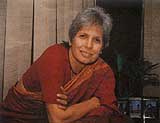
Aga, 56, is the chairperson of
Thermax Ltd, the Rs 520-crore
Pune-based energy and
environment major. Aga has
been working in Thermax since
1985 and headed the company's
human resource function before
she took over as the chairperson
of the Thermax group in
February 1996, after the death 
of her husband, Rohinton Aga.

was not an order lost but a customer let down and a complaint unfulfilled. Since he encouraged innovation and there were many FOAKs, he was prepared for the financial cost of making changes till the customer was satisfied.

After we went public someone said that now he could relax, but he said: "Now I have to be extra careful not to betray the trust the shareholders have bestowed on my company."

After Burmah-Shell he joined Duncan Jute Mills in Kolkata. My brother and Rohinton were good friends and my brother was very keen that Rohinton join our family business. At that stage it was a small, unknown unit in Bombay's Naigaon, making sterlizers and hospital furniture. There were public, smelly toilets opposite the factory and the entire ambience was very different from Burmah-Shell or Duncan. In spite of being offered a lower salary and no fancy perks, Rohinton took up the challenge to work for my father because he had confidence in his ability to make a difference.

Another quality Rohinton displayed as a leader was his faith in people and their ability to make a difference. With his vision and passion for work he was able to attract and retain talent. With empowerment and freedom Thermax became an engineering company despite Rohinton not being an engineer. The non-hierarchical, informal and challenging culture he created enticed many employees to give out their best and have a sense of ownership towards the company.

Prakash Kulkarni joined the company (then Wanson) as a stopgap arrangement till he could look for a better job in Mumbai, but he stayed for 30 years and is our present managing director. Research and development (R&D) head Dr N D Joshi had a scholarship from the UK and Rohinton persuaded him to stay on, and now Dr Joshi proudly says: "This is my first and last job."

Rohinton encouraged innovation and creativity in all areas, whether it is R&D or human resources (HR). Many eccentric, unusual personalities got attracted to the Thermax culture and he had the ability to manage these wild horses.

He encouraged differences to surface and in Fireside (the house magazine of the Thermax group), our HR head Prasad Kumar openly disagreed with Rohinton's viewpoint on the committed manager verses the professional manager.

Rohinton had created a forum called MARG - Management Apex Review Group - to discuss and arrive at major decisions that affected the company. Rohinton would vehemently put forward his view and yet always maintained that like every member of MARG he had only one vote and that was not the casting vote.

Faith in people translated itself by not having written-down manuals and elaborate systems. Of course, we were small in those days, but even when we grew our entire human resources policy was based on trust in our employees. Today, a lack of systems orientation has got us into trouble, but in those days it gave power to people and made for a nimble organisation.

Valuing competence above any other criteria was another leadership quality. In those days many family-owned organisations gave preference to people belonging to the same region or religion or to their own relatives.

When I joined Thermax in HR, I worked with Prasad Kumar for five years and when Prasad decided to leave the company, my husband asked him who was ready to take over from him and he suggested my name.

My daughter and son joined Thermax as trainees and Rohinton would often say that the shares belong to the family but the company will be managed by the most competent - they may be family or non-family.

Though Rohinton spoke excellent English and had many westernised habits and a brilliant academic record, he felt these were all superficial non-issues, and while recruiting he looked for competence and basic human values as the prime parameters. Since we could not afford high salaries, we were unable to attract students from IIMs but Rohinton, with his investment in people, could turn students from not-so-known institutes into excellent managerial material.

Rohinton was a very good listener. Someone has said that God meant human beings to listen twice as much as talk and hence gave us two ears and one mouth. He could communicate very effectively with people and was the darling of the Press. His ability to communicate was not only because of his brilliance or command over the English language but also because he was authentic and he genuinely believed in what he said. He communicated to express rather than to impress. He was also a voracious reader.

Sharing his experience and wealth with employees and others was another quality. At a month-long training programme conducted by IIM-Ahmedabad, Rohinton was selected to go for a four-month management development programme at Harvard on a full scholarship. Rohinton gained a lot from this programme and decided that as soon as Thermax could afford it, he would sponsor his colleagues.

Up till now we have sent nine executives for a similar programme at Harvard. Two years ago it cost the company 25 lakh to sponsor an executive at Harvard. Rohinton did not take any bonds because he felt that because one's heart is not with us there is no point in holding on to a person. Three people who have undergone the Harvard programme have left us.

Before Thermax went public, out of his personal holdings Rohinton gave shares to several of his senior colleagues. The shares were issued to select employees at Rs 10, whereas the public offer was at Rs l90. Out of his shares he created a welfare trust for the medical and educational needs of the employees and their dependents.

He genuinely believed that the wealth that you create is not only for your personal consumption but is to be treated as a trust and to be used for social causes. He gave his time and money to various worthwhile causes.

In the way Rohinton behaved with others, he demonstrated another leadership quality. He used to say: "You may be the boss or the owner but you have to treat everyone with respect and dignity and not let your position or wealth go to your head." Employees have said that whenever they come out of his cabin, they felt enriched and charged because of the way he treated them. He believed that it is a team - a set of dedicated people - who make things happen and he did not greatly differentiate himself from others by way of salary or perks.

At one of our newly formed joint ventures, the JV partner humiliated the Thermax representative by asking him to vacate his chair immediately and move out. Rohinton was furious and called the foreign representative to our house and let him know the values under which he operated, and never to humiliate a human being.

In those days Thermax was a very successful growing company and competition was not fierce, but in today's time, when performance is critical and survival is at stake, I wonder how Rohinton would have dealt with the issue of downsizing. He considered his role as an employment generator and offering VRS and asking people to leave would have caused him a lot of pain.

Today people cite the example of Infosys's N R Narayanamurthy cleaning his own toilet. This is a symbolic gesture in a country that has no dignity of labour. Similarly, in Pune, people talked about Rohinton travelling by rickshaws or, if need be, by second-class in a train. He used to say that if it is needed, even a clerk can charter a plane or a boss can travel by bus. The external perks do not define a man and in the end it is personal power, and not position power, that counts.

There is a saying: "All that you do, do with all your might, things done by halves are never done right." Rohinton was a follower of this saying and in many ways was a perfectionist. Being an intellectual, he was invited to many forums to deliver talks, and his talks and articles were well received. He toiled for days to prepare his speech or his article because he felt he owed it to his audience to give out his best. He often struggled to find the right word. The same perfection he expected in his company. He defined quality as: "I care, and if you care you will give out your best."

In his book Changing the Mind, he wrote (and I quote): "In the final analysis quality is not just a product, nor is it just a package of services and attributes. Quality is a way of life. Quality is a shop where materials move in an orderly way. Quality is an office where work is accomplished with neatness and quiet efficiency. Quality is a factory where scrap is stored where it should be. Quality is a person who responds to a telex within 24 hours. Quality is a telephone operator who tells the caller to hold on to the line while she makes a connection. Quality is a sales engineer who does not oversell his product. Quality is a manager who honours his commitment."

In 1983 Rohinton had a massive heart attack and had to go to the UK for a bypass surgery. On the second day of the operation he had a stroke and his right side was affected and had memory loss. He did not recognise me, forgot his alphabets. During that time he exemplified another quality and that is: never give up.

For days and months he practiced and re-learnt the alphabets and numbers. The physiotherapist in London said that since his right hand grip was affected due to the stroke he would not be able to tie his shoelaces for at least a month. He was asked to practice tying a big ribbon on his thigh. He stayed up the whole night and kept trying, and in the morning when the physiotherapist came in she was amazed to see that he could tie his shoelaces.

He was very angry at the world but, as I said earlier, he never gave up. It was after his stroke that his book, Changing the Mindset, was published. He became the chairman of the Confederation of Indian Industry's energy cell and took delegations abroad. He was invited by the US and Manila School of Management to deliver talks.

Being a perfectionist, after the stroke, it took far more energy and effort to accomplish things well. He increased his hours of work and became a workaholic. His working day often stretched from 9 am to 10 pm and he also worked on weekends, but he did not compromise or lower his standards. If his children needed help with their homework he would gladly be up by 4 am and create time for them.

Rohinton had a keen sense of humour and I think this a very valuable asset for a leader. He had the ability to laugh at himself. After his stroke I could make fun about his impatience and both of us often laughed through those difficult days.

Though Rohinton was a very successful leader, he as was also human. I would not like to paint him as someone who had no faults. With all his intelligence, he abused his body by smoking and not having control over his diet. A leader owes it to himself and to others that he takes care of his health needs.

Rohinton found it difficult to deal with unpleasant things, including confronting people. At times he tended to be an ostrich. A leader has to build the ability to deal with issues as and when they surface rather than sweep them under the carpet. In today's tough market scenario, a leader will be pushed to take many unpopular, unpleasant decisions. However, these can be carried out with a human touch.

Rohinton did not clearly identify and invest in his successor. M S Banga of Hindustan Lever told us that when he was appointed as the head of HLL his boss called him and said the first thing he should do as the head is to identify and groom his successor. Whichever stage of the hierarchy you may be, coaching and investing in your successor is a must for the ongoing success of the organisation.

I started my talk by saying that my definition of success does not mean winning at work and losing in life. I have seen many corporate leaders being acclaimed at work and being terrible human beings. They have let down their families, trampled on their colleagues and compromised their values while climbing up the corporate ladder.

At the end of the day all human beings are seeking the same goal - being happy. Success and accomplishments do bring happiness, provided you have done it by fair means and can live with yourself. As Dale Wimbrow says in his poem:
"You may fool the whole world down the pathway of life
And get pats on your back as you pass
But your final reward will be heartaches and tears
If you've cheated the man in the glass."


 search domain-b
  go
 
A leader par excellence