|
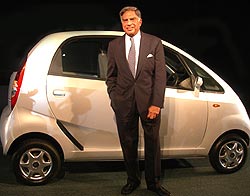
New Delhi: The rear-wheel drive, all-aluminium, two-cylinder, 623cc, 33 PS, multi point fuel injection (MPFI) petrol engine Nano is expected to have an on road price of around Rs115,000, inclusive of VAT, transportation costs from the factory, individual registration and insurance. To view the photo gallery of this vehicle, click here. The car is 8 per cent smaller than the Maruti 800, its closest comparison, though it is 21 per cent roomier inside. This is also the first time that a two-cylinder gasoline engine is being used in a car, with single balancer shaft. That being just one of the host of innovations that have gone into the development of a car that has been the talk of the global auto industry for the past several months, the car already seems set to replicate the popularity and success of another product that bears the name 'Nano', a small, snazzy looking I-Pod that has endeared itself to the hearts, minds, and ears of millions across the globe. Unveiled by Tata Group chairman, Ratan Tata, the Nano's launch was preceded by a walkthrough by Tata himself, on the journey that Tata Motors went through over the four years it spent developing the car from the concept stage. The 'people's car', designed with a typical middle-class family that relies on a two-wheeler, has a roomy passenger compartment with generous leg space and head room and can seat four persons comfortably. Four doors with high seating position make ingress and egress easy. The Nano's lean design strategy has helped minimise weight, which helps maximise performance per unit of energy consumed and delivers high fuel efficiency. Performance is controlled by a specially designed electronic engine management system. Mr Tata said the Nano would give a mileage of around 20 kilometres per litre of petrol, and conforms to all legislative requirements in force today. Speaking at the unveiling ceremony of the Nano at the 9th Auto Expo in New Delhi this morning, Ratan N. Tata said, ''I observed families riding on two-wheelers – the father driving the scooter, his young kid standing in front of him, his wife seated behind him holding a little baby. It led me to wonder whether one could conceive of a safe, affordable, all-weather form of transport for such a family. ''Tata Motors' engineers and designers gave their all for about four years to realise this goal. Today, we indeed have a people's car, which is affordable and yet built to meet safety requirements and emission norms, to be fuel efficient and low on emissions. We are happy to present the people's car to India and we hope it brings the joy, pride and utility of owning a car to many families who need personal mobility.'' The Nano's safety performance exceeds current regulatory requirements, said Tata. With an all sheet-metal body, it has a strong passenger compartment, with safety features such as crumple zones, intrusion-resistant doors, seat belts, strong seats and anchorages, and the rear tailgate glass bonded to the body. Tubeless tyres further enhance safety. Tata added that the car had passed the full frontal crash tests that are mandatory in India. Additionally, it has also been designed to pass the offset and side impact tests that are mandated across the world. Needless to say, this means that the car will most definitely find its way into overseas markets. Saying that the car conforms to the prevalent Bharat Stage 3 (BS III) emission norms, and ''will meet the Euro 4 standards'' Tata took a light-hearted dig at Dr R K Pachauri's much publicised concerns about the impact of the car on the environment, ''Dr Pachauri need not have nightmares.'' On the naming of the car, Tata said the name 'Nano' was chosen, as it ''connotes hi tech and small size.'' Tata also said that though input costs of steel, tyres, and the other parts had gone up substantially since the time it was conceptualised four years ago, the dealer price of the standard version of the Nano would be Rs1 lakh, because ''a promise is a promise,'' he emphasised. The car will be launched commercially in India later in the year.. (Also see: Why critics of the Tata small car are barking up the wrong tree)
|