|
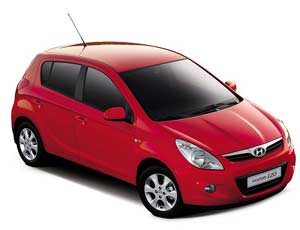
Hyundai has upped the ante in the hatchback wars with the introduction of the i20. How does it stack up against the Maruti Swift and its cousin the Hyundai Getz? Sourya Biswas finds out. Hyundai has upped the ante in the hatchback wars with the introduction of the i20. With this new car, the Korean giant hopes to replicate its earlier success with the i10, which had swept all the major Indian ''car of the year'' awards last year and endeared itself to the Indian public. But does the i20 have what it takes to overthrow the Maruti Suzuki Swift from its premium hatchback perch? . Before embarking on the merits and demerits of the i20 vis-à-vis the Swift, let's take a trip down memory lane and examine the adversarial relationship between Maruti and Hyundai in India. The Maruti 800 was the car that defined new-age motor cars in India, and with the Zen and Alto introduced in 1993 and 2000 respectively, the company offered everything the middle-class Indian customer wanted. Almost. Along came Hyundai with its Atos in early-2000, and the small car scene in India was never the same again. For the first time in its illustrious career, Maruti had a serious competitor for the affections, and wallet, of the Indian customer. The Atos, rebadged as the Santro, shocked many with its radical tallboy design, but proved to be an instant hit with buyers. Buoyed by an advertising tsunami spearheaded by the biggest star in the country, Shah Rukh Khan, and the continual facelifts, the Santro sold in huge numbers. But Maruti maintained its top position courtesy the Alto, the most popular entry-level car on Indian roads. Hyundai didn't ''Getz'' it Hyundai then sought to move up the hatchback value chain by offering the Getz. However, the Indian consumer wasn't willing to pay top rupee for a premium hatch and sales weren't encouraging. Of course, things weren't improved by Maruti introducing the Swift soon after, which effectively monopolised the premium hatch segment. Hyundai's response was extremely intelligent. It saw a gap in the mid-level hatchback segment and moved quickly to capitalise on Maruti's absence in this segment. Hence, was born the i10. Positioning the car as ''launched in India, exported to the world'' was a risky gamble, but it paid off handsomely for Hyundai as auto journalists went into raptures over the car's punchy Kappa engine and polished interiors. They did not hesitate in crowning the i10 as India's ''car of the year'', and the Indian customer concurred. A-Star is born However, Maruti Suzuki was not one to sit idle. Already presiding over the entry and premium hatchback segments courtesy the Alto and the Swift, the Indo-Japanese giant had no intention of yielding space in the mid-segment to this new pretender. In a marked departure from its Japanese lineage that saw Suzuki cars being modified for Indian conditions, Maruti designed the A-Star from the ground up as an Indian vehicle. This was supposed to be the car that recaptures the missing mid-hatchback superiority from the i10, but fell short of this requirement. Even with jazzy looks and chart-topping mileage headlined by Farhan ''Rock On'' Akhtar, the A-Star failed to rock the mid-level hatchback segment. Its drawbacks include the less-than-impressive interiors, cramped rear seats, underpowered, though frugal, engine, and the uncompetitive pricing. At least for the present, the Hyundai i10 has no serious competition. The new kid on the block But Hyundai was not one to rest on its laurels, either. Having tasted success, the Korean manufacturer moved quickly to strike a blow at Maruti's leadership in the premium hatch category with the i20. Having learnt lessons from the Getz debacle, the i20, though pricey, has been introduced loaded with features not seen before in a small car, barring the extremely expensive, and unpopular Skoda Fabia. The Hyundai i20 is a five-door hatchback car that made its debut at the 2008 Paris Motor Show in October 2008 and arrived on sale in late 2008 - to fit between the i10 and i30 and to replace the Getz globally. However, Hyundai has stated that India will be an exception where both the i20 and Getz will co-exist for the time being. The car has been manufactured at Hyundai's Chennai facility in India. A small aside here. The i30 is a small family car designed by the Hyundai European Team in Germany (incidentally, the i20 also has its origin there). It is available in South Korea, Europe and Australia as a five-door hatchback or estate, with a choice of three petrol and two diesel engines, either with manual or automatic transmissions. It shares mechanical components with the Kia cee'd although there are enough bodywork modifications to make both cars appear individual. It is expected to be introduced in North America this year with the India launch expected soon after. Impressive exterior, middling interiors At first glance, the i20 gives a favourable impression, a consequence of its resemblance to the i10. As far as the Getz is concerned, the i20 is longer, lower and wider. So while its predecessor was instantly forgettable, the newcomer is rather stylish. There's neat detailing around the front and pronounced lines that run the length of the doors. The front is designed with a low-slung grille, good large headlamps and cool sporty round fog lamps. The steep raked windscreen flows smoothly and then it merges with a novel tail section. Looks wise, it does seem to have an edge over the Swift, which has began to show its age. The i20 is one of the biggest cars in its class, almost reaching the dimensions of the overpriced Skoda Fabia. In fact, it is much larger than it's closest competitor the Maruti Swift. And this size translates into much interior space as well. The 295-litre boot space is the largest in its segment, comparing favourably with many sedans. It is spacious enough to accommodate multiple suitcases for that occasional outstation trip, provided the passengers feel comfortable enough spending hours in the car. And this is where Hyundai slips up a little. Not only are the rear seats too upright, they have little legspace for the tall traveller, thereby translating to an uncomfortable experience on longer journeys. Moreover, the middle portion of the rear backrest has an unseemly bulge, adding to the discomfort for the middle passenger. However, the i20 redeems itself somewhat with the driver's seat. Although the visibility is not as good as the Santro Xing (which many consider the benchmark in hatchbacks), it comes with the option of various kinds of adjustments, a perk that extends to the steering column as well. However, the turning radius is a bit large as compared to the Swift and may cause problems in cramped city conditions. Loaded with goodies The i20's well-packaged interior boasts of generous levels of standard equipment. All the i20 models have AC / heating, dual tone beige interiors, 2 DIN CD + MP3 Music System, front and rear power windows, refrigerated glove box, a multi information display (which includes trip distance, engine running time, calendar, clock, temperature and audio display) and tachometer, as standard equipment. While the top-end model of the i20 comes with features like fully automatic A/C, leather wrapped steering wheel and TGS knob, steering mounted audio control (a first for this segment), foldable key with keyless entry function, alloy wheels, height-adjustable driver seat, electrically foldable and adjustable outside mirrors and the category-first six airbags. The quality of plastics is excellent, much better than the Swift's. The heart of the i20 The heart of a car is its powerplant, and here the 1.2L Kappa engine delivering 80bhp@5200 rpm is found to be somewhat lacking. The same engine that blew the i10's competition away is found to be underpowered in the heavier i20 is concerned. Moreover, the respectable mileage that one experienced with the i10 is distinctly lacking in its heavier cousin. Although city driving is comfortable enough, overtaking on the highways canbe sluggish. Peppiness is one aspect in which the i20 lacks behind its predecessor, the Getz Prime. While the petrol powerplant in the latter delivers only 3bhp more than the 1.1L Kappa, it is sufficient to make the lighter Getz zoom on city streets. Of course, if the diesel 1.5 GVS Prime is concerned, the massive 110bhp of power beats the i20 by a long distance. For that matter, it smokes several higher-priced sedans as well. Is pricing a concern? Where Hyundai seems to lose the plot is the pricing. The base version of the i20 costs about Rs5.6 lakh on-the road, while for the same price one can actually get the fully loaded Swift ZXI or even the Swift VDI diesel, which are much better value propositions. Even though the base i20 is pretty well equipped, it does not have the ABS and airbags like the ZXI. If one were to opt for the mid-level trim of the i20, one does get a fully loaded car. However, it comes at a price almost Rs50,000 more than the similarly equipped Swift ZXI. Considering that the latter comes with a more powerful fuel-efficient engine, the more modern interiors and larger boot space of the i20 doesn't justify the premium. Also, Maruti after-sales service is cheaper and widely available. Note: The i20 with its 1.2L engine enjoys government excise benefits of a small car, which the Swift doesn't. Therefore, some price rationalization will definitely help Hyundai's case. Conclusion If you are looking for power, buy the Getz Prime 1.5 GVS. If you are looking for fuel economy, buy the Swift VDI diesel. If you are looking for a petrol car with moderate economy and comfortable features, buy the Swift ZXI. If you are looking for a fully loaded city car with the latest technology and safety features, buy the i20. The i20 will sell well, though perhaps not as well as the i10. In fact, several Hyundai dealers already have a 45-day waiting period for the former. However, in all probability, the Swift will continue to rule the premium hatchback segment for some time to come. Comparison by numbers Since we are looking at premium hatches with multiple options here, we will compare trims at similar price-points and not the base versions. Therefore, the candidates for this exercise are the mid-level i20 Asta, the highest-level Swift ZXI and the premium Getz Prime GVS. | Parameters | Hyundai i20 Asta | Maruti Swift ZXI | Hyundai Getz Prime 1.5 GVS CRDi | | Dimensions | | | | | Overall length | 3940 mm | 3695 mm | 3825 mm | | Overall width | 1710 mm | 1690 mm | 1665 mm | | Overall height | 1505 mm | 1530 mm | 1515 mm | | Wheelbase | 2535 mm | 2390 mm | 2455 mm | | Ground clearance | 160 mm | 170 mm | 160 mm | | Front track | 1505 mm | 1470 mm | 1450 mm | | Rear track | 1503 mm | 1480 mm | 1440 mm | | Front headroom | NA | NA | 980 mm | | Front legroom | NA | 1110 mm | 1160 mm | | Boot space | 295 litres | 232 litres | 290 litres | | Kerb weight | 1197 kg | 1075 kg | 1137 kg | | Fuel tank capacity | 45 litre | 43 litre | 45 litre | | Fuel efficiency | | | | | Mileage (city) | 10.5 km/litre | 11.5 km/litre | 12.5 km/litre | | Mileage (highway) | 14.0 km/litre | 15.8 km/litre | 20.9 km/litre | | Mileage (overall) | 11.0 km/litre | 12.4 km/litre | 16.6 km/litre | | Performance | | | | | Maximum speed | 153 Km/Hour | 160 Km/Hour | 171 Km/Hour | | 0-100 kmph | 15.4 seconds | 12.9 seconds | 11.3 seconds | | 80-0 kmph | 36.7 m | NA | NA | | Engine | | | | | Engine type | 1.2L Kappa | 1.3L 4-Cylinder Petrol | 1.5L 4-Cylinder DOHC Diesel | | Displacement | 1197 cc | 1298 cc | 1493 cc | | Power | 80bhp@ 5200 rpm | 87bhp@ 6000 rpm | 110bhp@ 4000 rpm | | Torque | 112Nm@ 4000rpm | 113Nm@ 4500 rpm | 235Nm@ 1900rpm | | No. of cylinders | 4 cylinder | 4 cylinder | 4 cylinder | | Transmission | | | | | Transmission type | Manual | Manual | Manual | | Gears/Speeds | 5 Gears | 5 Gears | 5 Gears | | Suspensions | | | | | Front suspension | McPherson strut and coil spring | McPherson strut and coil spring | Independent McPherson strut with torsion bar | | Rear suspension | Torsion beam and coil spring | Torsion beam and coil spring | Dependent torsion beam axle and coil spring | | Brakes | | | | | Front brakes | Ventilated discs | Ventilated discs | Ventilated discs | | Rear brakes | Drum | Drum | Drum | | Wheels | | | | | Wheel type | Steel | Steel | Steel | | Wheel size | 14inch | 14inch | 14inch | | Tyres | 185/65 R14, Tubeless | 185/70 R14 (tubeless) | 175/65 R14 | | Price (Ex-showroom) | | | | | Price (Mumbai) | Rs.5.87 lakh | Rs.5.38 lakh | Rs.5.71 lakh |
|