|
Google's Chrome browser, launched just a few days ahead of the company's tenth birthday, has already elicited considerable response from the World Wide Web, both positive and negative. While supporters rave about the minimalist appearance, which reflects the search engine's homepage and yet delivers astounding performance, naysayers criticise the lack of certain features users take for granted as well as the company's feared privacy policies which had been criticized by wannabe Google startup, Cuil. (See: Google launches own internet browser 'Google Chrome' and Google gears up for a ''Cuil'' challenge)
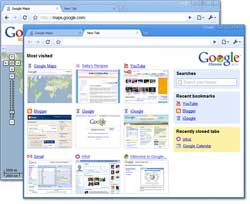
First, the positives. Many users rate Chrome faster than Internet Explorer, even matching up to the blistering speeds achieved by Safari. In fact, some assert that Google's offering beats Mozilla's iconic product as far as the simultaneous opening of multiple web pages are concerned. Chrome uses a system that helps keep your computer running even when an application freezes. Unlike other browsers, each website open in Chrome runs as a separate browser; if one stops working it shouldn't affect the others. A third positive is the way Chrome simplifies the file download process. It's the first browser to download documents without opening a separate window. It creates an unobtrusive downloads bar and file icon at the bottom of the browser which can be clicked to open the file. Now, the shortcomings. First and foremost, it's a beta version, or one still under testing. Therefore, bugs may be quite a frequent occurrence, at least for the near future. Again, Chrome does lack certain features that some people might miss, including a menu bar (with function categories like File, Edit and View), a status bar, and an option to organize bookmarks. The Google Chrome team said they plan to add that last feature at some point. At present, features are at a minimum - back and forward buttons, a refresh button, an add-to-bookmarks star icon, a page icon with a drop-down list that includes Find in page (a page search function), Text zoom (for increasing or decreasing font size) and Copy and Paste. There's also a wrench icon with a drop- down list that includes Options, History and Downloads. Another question mark is that regarding privacy concerns. Google already admits to collecting personally identifiable information. In fact, conspiracy theorists are already having a field day propounding the so-called ''real reason'' behind the seemingly altruistic introduction of a free and powerful browser technology. Theories include secret tracking devices to provision for protecting Google's interests against the company on whose product a majority of the world's computers run - Microsoft. The Google conspiracy-minded folks are all panicked about any hint of tracking like the comment above and other items found in the Google privacy page that suggest unique tracking: Your copy of Google Chrome includes one or more unique application numbers. These numbers and information of the browser (e.g., version number, language) will be sent to Google when you first install and use it and when Google Chrome automatically checks for updates. However, considering Chrome is open-source and anyone can check its code, some of these concerns may be assuaged.
|