|
Powered by high performance engines, with a lightweight frame, and designed for optimum speed, super bikes have always captured bikers' imagination. We take a closer look and analyse as to what makes the Japanese 1000cc bikes market leaders in the super bikes category.
Super bikes are popular motorcycles, with large sales volume and profits. The bikes are powered by larger engine capacities ranging from 800cc to1100cc. Like cars, bikes are also classified by their engine capacity, measured in cc (cubic centimetres), which represents the combined size of the engine's cylinders. Super bikes with a displacement very close to 1000cc are sometimes referred to as ''litre bikes'' as the engine displaces approximately one litre.The bikes are designed for optimum speed, acceleration, braking and maneuverability. They have an advanced aerodynamic design than other classes of bikes and are usually used in high-performance situations such as a race. Leading Japanese bike manufacturers such as Suzuki, Honda, Kawasaki, and Yamaha have crafted a niche for themselves in the 1000cc category. The Japanese giants have done extensive research on motorcycle ergonomics of the seating posture, vehicle weight, fuel efficiency and paid attention to details to ensure that their bike gives optimum performance and also ascertain their position as market leaders in the 1000cc super bikes category. Let's look at the four most popular super bikes - coincidentally all from Japan. Suzuki GSX-R1000
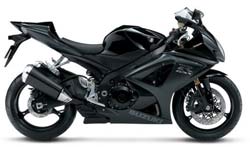
The GSX-R1000, is a sport bike from Suzuki's GSX-R series of motorcycles. It was introduced in 2001 to replace the GSX-R1100. The latest model of the GSX-R1000, unveiled at the 2007 Paris motor show is powered by a 999cc inline four-cylinder 4-stroke engine. The 2007 model is a bit heavier than the previous model with new exhaust system and new emissions regulations. Ergonomics and wind protection are pretty good on the Suzuki, as is the seat and the suspension compliance. Some of the key features of the 2007 GSX-R1000 include: - Compact fuel injection system
- Powerful engine management system, allowing the rider to choose from 3 engine settings to match riding conditions
- Self adjusting hydraulic clutch, which minimises changes in clutch feel over a long race
- A trapezoidal shape larger radiator with 10per cent more cooling capacity
- A new easy-to-read instrument cluster, including a step motor controlled analog tachometer, digital LCD speedometer, dual tripmeters, clock, convenient gear position sensor, rpm indicator light and a new LCD engine mode indicator
Honda CBR1000RR
Launched in 2004, the CBR1000RR (also known as the Fireblade) is powered by a 998cc DOHC engine. The all-new CBR1000RR was introduced at the Paris International Motorcycle Show on 28 September 2007. Key features:
- New intake and exhaust porting
- Computer-controlled digital ignition with three-dimensional mapping
- Titanium valves and an enlarged bore with a corresponding reduced stroke
- Revised front and rear suspension.
Yamaha R1
The Yamaha YZF-R1, introduced in 1998, is Yamaha Motor Company's third generation super sport motorcycle. Powered by a 998cc DOHC powerful engine and packed with trickle-down MotoGP technology, the YZF-R1 is the most advanced open-class production motorcycle ever built Key features:
- The YZF-R1 uses the YCC-T fly-by-wire throttle system for flawless response under all conditions.
- Inline four-cylinder engine is the most powerful, tractable R1 powerplant ever, thanks partially to the world's first electronic variable-length intake funnel system.
- Slipper-type back torque-limiting clutch greatly facilitates braking / downshifting from high speed.
- Aluminum Deltabox frame and swing arm take Open-class handling to the next performance level.
- Six-piston radial-mount front brake calipers and 310mm discs generate the kind of braking power a bike like the R1 requires.
Kawasaki ZX-10R
The Kawasaki Ninja ZX-10R has a 998cc 4-Cylinder, DOHC engine. Despite relatively small discs, Kawasaki has engineered an extremely stiff caliper and pad combination that provides excellent feel and power. Key features:
- Very compact, narrow and lightweight design
- One-piece upper crankcase and cylinder casting saves more than two pounds and offers increased rigidity
- Specially designed internal fins on the liquid-cooled, aluminum oil cooler for high-efficiency heat dissipation
- High-speed 32-bit ECU processor provides precise engine management
- Short, compact frame allows the swingarm to be longer, which makes it easier to control rear wheel powerslides
Specifications | | Suzuki GSX-R1000 | Kawasaki ZX-10R | Yamaha YZF-R1 | Honda CBR1000RR | | Engine capacity | 999 cc | 998cc | 998cc | 998cc | | Transmission | 6-speed, constant mesh | 6-speed | 6-speed w/multi-plate slipper clutch | Cassette-type, close-ratio six-speed | | Ignition | Digital/transistorised | TCBI with Digital Advance | TCI | Computer-controlled digital transistorized with three-dimensional mapping | | Length | 80.5 inches | 81.3 inches | 81.1 inches | - | | Width | 28.3 inches | 27.8 inches | 28.3 inches | - | | Height | 44.5 inches | 44.5 inches | 43.7 inches | - | | Fuel tank capacity | 18 litres | 19.8 litres | 20.92 litres | 21.14 litres | | Dry weight | 172 kg | 175 kg | 176.9 kg | 175.9 kg | | Price in $US | $11,399 | $11,249 | $11,699 | $11,499 |
|